¯"I read the news today, oh boy. The Portage Theater has just closed it's doors" ¯ to paraphrase The Beatles "A Day in the Life." The Portage was built in 1920 and received preliminary landmark status in 2012. Chaplin's The Great Dictator was deemed too controversial, thus premiered at only 2 theaters in Chicago, the Music Box and Portage in 1940. In 2008, a scene from Public Enemies (released 2009)with Johnny Depp was filmed here in lieu of the Biograph Theater (Depp played gangster John Dillenger who was gunned down after watching Manhattan Melodrama 1934).
My feet with original tile floors from 1920
Magnificent Portage Grande Cinema Organ
The Portage was almost sold to a mega church (summer 2012) but to grassroots activism in the community saved it! This video of surrealist Time Lord flapper dance was to celebrate the fact that the Portage wasn't sold back then. Now, sadly, it is under new ownership which has shut it's doors and gives no public statement as to what it plans to do with the building.
Dave McKean, illustrator for Neil Gaiman's Sandman and numerous other graphic novels, came to the Portage Theater to screen his short films and his full length film Mirrormask, written by Gaiman. Also on exhibit were McKean's paintings inspired by German expressionistic films from the Weimar Republic (1919 - 1933) produced by the Ufa film company in Berlin.
Dave McKean painting inspired by M (dir Fritz Lang, 1931)
Dave McKean signing his books
Cabinet of Dr Caligari by Dave McKean
Inpromtu flapper dance film (below) filmed by Chicago Surrealist Group member, DainaSurrealism & actor/model, Jacob. Portage Theater, built 1920. View VIRAL Chaplin dance w/ my band, "Hypnagogic Telegram." http://youtu.be/wtLGzLsvhiI (Georges Melies film "Trip to the Moon" 1902) backdrop. Electronica inspired by Dreams, fleeting aspects of time, Lewis Carroll, Dr Who (Trock), & Fortean Phenomena. This was filmed after screening of "The Artist" when film's theme song played on loop (Chicago). Any excuse for a surrealist to play dress-up
(Song: The Artist Theme Song - George Valentin ( Ludovic Bource )Film "The Artist" by Michel Hazanavicius, French director of Lithuanian origin (Lietuvis). Lietuvaite soka kaip Flapper! Vasario 16 Gimnazija studente Cikagoje. Lithuanian surreal artist. Labas!)
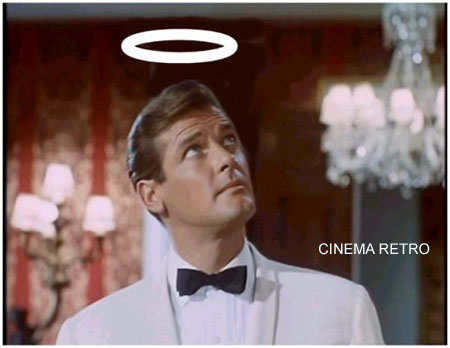
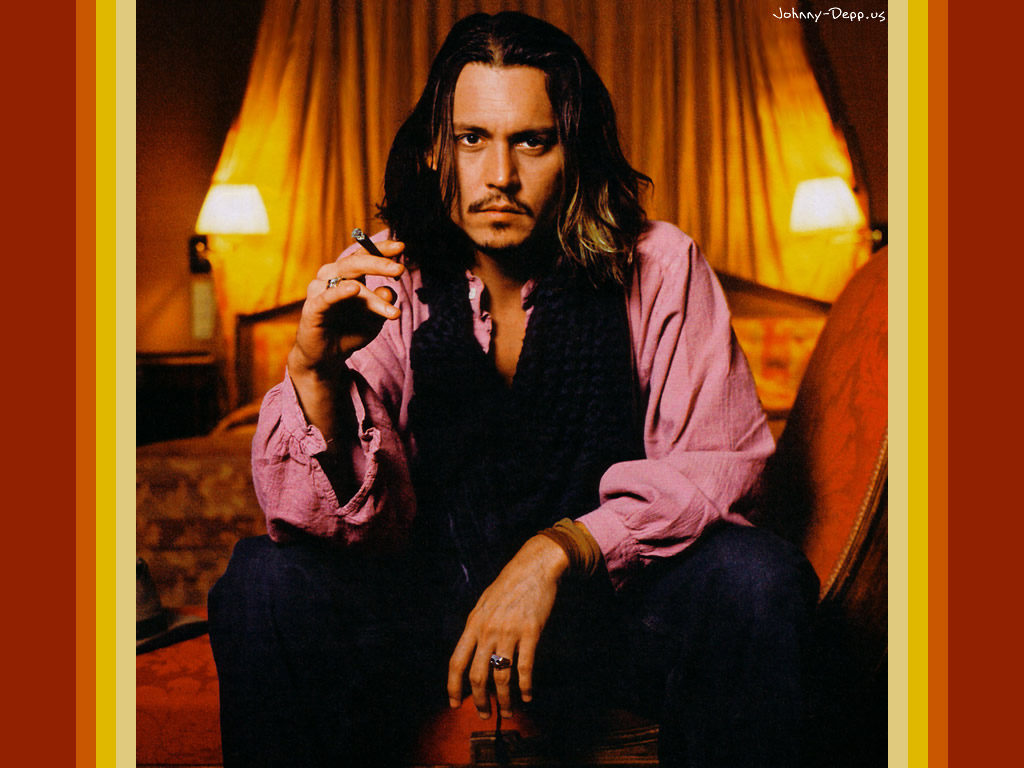
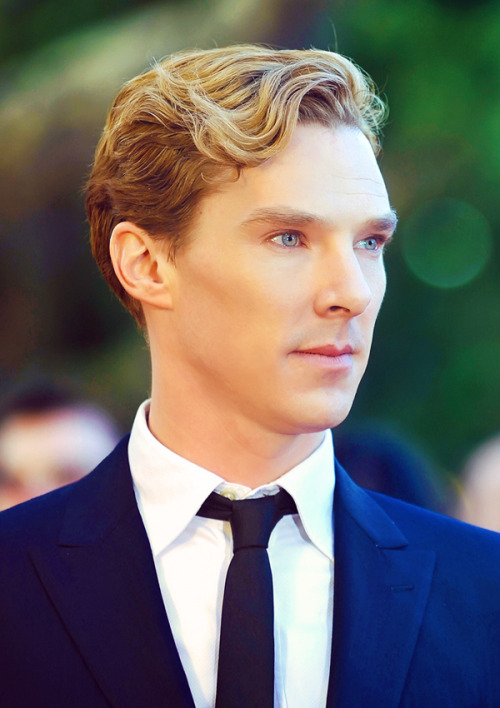
Silent and classic film is a major inspiration for my project. See picks of beautiful men from the history of Hollywood in my Elegance of Masculine Beauty: Hollywood Inspiration (Valentino, James Dean, Roger Moore, Depp, Cumberbatch, et al)
Rudolph Valentino
James Dean
Roger Moore as The Saint
Johnny Depp
Benedict Cumberbatch
A propo silent film, the Portage held an annual Silent Film Fest Chicago every summer. That has now moved to Pickwick Theatre in Park Ridge, IL.
The Black Pirate (1926)
Sunday, April 28, 7:30 p.m. Pickwick Theatre 5 South Prospect Ave, Park Ridge, IL
Other Portage Theater events will have new venues. Find updates on these sites.
STRANGE INTERLUDE: My Vaudeville, Time-Travel inspired band, "Hypnagogic Telegram" is going VIRAL on Youtube. I play a literal personification of a Time Ghost (Zeitgeist) that inhabits the wardrobe closet of the TARDIS. I come out in costumes from various eras to dance & sing in styles from those eras. Film in background isGeorges Milies'Trip to the Moon (1902) silent classic. If Doctor Who would have a band, it might sound like this.
There are various assumptions, projections, and stereotypes about the famous. I'm writing in order to dispel these myths which float about in our celebrity culture. Someone once told me, "You don't get fangasms because you worked in the film industry." "No," I replied, "it goes back further than that." I grew up around prominent individuals; some are friends, schoolmates, family, peers; others are professors, doctors, mentors, and even enemies. Some of them live in the US, some in other countries. Some of them inspire me, some repel me, and some lie somewhere in between.
It was a famous critic who inspired me to start a blog to begin with. I took an honours class which he taught and we were to post our homework assignments on a blog. That made me post my art on here, and the rest is history. For this, I thank him.
This is how I view fame...
People are strange when it comes to famous individuals, I've noticed that ever since my childhood. My first exposure to someone famous was with my godfather, who, as my daughter so simply puts it "got famous for jumping off a boat." He didn't jump off just any boat, he jumped off a Soviet vessel, landed on an American ship and begged for political asylum, thus making him a defector during the Cold War. When the American government decided to return him to the Russian authorities it became an international scandal. Hollywood produced a film about him. In my house we didn't have a television, but then one day my mum came home and exclaimed, "They made a film about your godfather, so I'm buying a TV so you can know his life story."
And Exactly How Strange is Fame?
But this is not a blog about him, it's about how strange things get when you know someone in the public eye. It took me many years to finally find the words to describe how this feels. There is an episode of "Doctor Who" called "Turn Left" in which the Doctor's companion, Donna, is told she has something on her back. She spends the rest of the episode trying to see what that something is but to no avail, for it is invisible. It turns out that some people can see it, while others are completely oblivious to its presence. Those few who see it freak out upon sight of it. Only toward the end of the show do we find out that this is a massive insect-like creature which has made her back its home.
To me fame is exactly that: some strange creature that has landed on the shoulders of some people I know. No matter how long and hard I look at these individuals, I can never see the creature that elicits such strange and abrupt reactions from people around them. Many times these reactions seem over-the-top and irrational. I've had to live with this as a constant in my life since I was a child. When I think about it, I can't help but wonder if these experiences and observations have somehow contributed to me becoming a surrealist. Every time I witnessed one of these strange reactions, I felt like I was Alice after she fell down the rabbit hole because everything got turned upside down and nonsense reigned supreme. Nothing made sense anymore: the fangasms, the "oh my God"s, the obsessions, they just left me confused because I still couldn't see that creature which they made such a fuss about. There were also ironic moments, when I would be at the home of someone in the public eye: two such friends, a continent and decades apart, broke down and cried telling me how lonely they felt. The first time it happened I was shocked. I was a teenager at boarding school with a famous schoolmate. The second time it happened, I wasn't surprised, I was expecting it.
How can Someone Famous Feel Lonely?
How, you ask? The same way someone popular can feel lonely. Fame is nothing more than a more exaggerated form of popularity, anyway. It's all a mathematical calculation. Popularity is a set of digits of how many people know someone and fame is just a set of higher digits (Google someone famous & observe the numbers). One recurring comment from such friends and family members is, "people look at me and they only see one thing: they don't see all the other sides of who I am." They may be surrounded by a lot of people, and be known by a lot of people, but it doesn't mean that they are close to a lot of people. The fact remains that most of the people in anyone's life are superficial, and that is a universal no matter how popular/famous one is. So, therefore, in the case of famous people, that would only be exponential. It's not how many people know you or that you know, it's how near and dear those relationships are that count. Quality versus quantity.
How Exposure to the Famous has Changed the Way I View Everyone
Maybe the fact that I grew up observing these prominent people made me realize exactly how multi-sided they were as individuals. That taught me how, no matter what others see, an individual is a multi-faceted gem which one can view from a plethora of different angles. I can't ever look at any person and only see one aspect of who they are, that to me is impossible. Not one single soul: not my professors, not my neighbours, not even my enemies. People are amazed at how I can calmly say positive things about my worst enemies. I can do so because I understand that they, too, are complex human beings. I may not like their behaviour, but I do admit when they have talent, intelligence, or are simply wearing a nice scarf. I look at famous people I don't know and ask myself: what languages do they speak, what books do they enjoy reading, what other talents do they have which only their friends know about? And so it goes full circle.
What Prompted me to Write this Article
Now onto my dying friend. He is a prominent artist with a wealth of knowledge from his numerous travels and life adventures. I love his philosophical side. He understands the deeper meaning in life and has always taken the time to share his experiences and hopes with those around him. The stories of his life which he shared with us will echo long after he has shaken this mortal coil. I will walk away with lessons from my years of knowing him. The walls of the places he's lived in were covered from floor to ceiling with frames containing illustrations and photographs representing the spectrum of the human race: everyone from the famous to the homeless are rendered in his work. That inspired me to take down some of my posters (designed by others) and put up more of my own artwork and photography. It's such a no-brainer for an artist to reserve whole walls for their artwork, yet, for some strange reason, I didn't think of doing it until I met him.
I told him about how I moved to Europe in my teens (without my parents, mind you) and of my adventures there. In turns out that those stories inspired him because he wrote this on a gift he gave me.
How Someone's Fame Presents Difficulties for Those Close to Them
Sometimes you are able to chat with these prominent individuals for as long as you are outside a building, but once you both go in, they get whisked away at the door and are constantly surrounded by people who want this, that, and the other from them. You spend hours observing the crowd surrounding them. It's hard to approach them, even as their friend. And why would you want to wiggle your way through the chaos, when you know that you can save that conversation for later, when you can sit at their dinner table, enjoy a nice cup of tea and chat leisurely for hours? I miss those kind of conversations with my artist friend. I had visited him at his last home, before he moved to his current location, and spent the entire afternoon chatting with him one-on-one. Grant it, a couple of people dropped in for brief moments, but we had most of the afternoon to ourselves. He had given me a massive spider plant, which I still have now. The offshoots of his plant remind me of the cycle of life. He is dying of cancer, but his plant grows and has new life with new potential in its offshoots. His plant will still be with me when he's gone. I know that would make him happy.
I so long to have one last face-to-face chat with him: I wish to say my farewell and give him another long hug. The last time I saw him was at the opening of his photography exhibit. The place was so full, that people were going outside into the frigid Chicago winter just for a breath of air. The flow of people wanting to chat with him was constant, I hardly had a chance to exchange a few sentences. Another prominent friend of mine had called me that afternoon to tell me she was coming to town, so we met at the exhibit. I hadn't seen her in years; we used to work at a bank together. That was before she had her singing career with hits songs in a few countries, before she embarked on tours. She lived out-of-town and that was a rare chance to see her. The connection on the phone was choppy, so I didn't understand her when she mentioned something about dialysis. Once I saw her I realized exactly how serious her condition was. She has kidney failure and had almost died. It was incredibly hard for me to be with two people who were so close to death. I couldn't help but think about how superficially society views the famous, but for me it was painfully obvious how human they really are. How much more human can you get when your body is failing you? I stood between them both as our photo was taken. I wished the crowd wasn't there so I could chat with both of them. I felt that I couldn't do enough as their friend that evening, I longed to connect with them on a deeper level than the situation allowed. I chatted with them for as long as I could. I closed my eyes as I hugged him and held on for a while, knowing it may be my last chance to do so. I was late for my following obligation that evening, which I couldn't get out of, but I didn't care. I only cared about the two of them. The crowd reminded me of how fame can sometimes be an obstacle.
His presence seems to follow me, and his fame only amplifies it. Even while I was on campus, I saw two newspapers with his face on the cover. He was interviewed on the radio. Those are bitter reminders of how hard it is for me to see him in person. How Murphy's Law prevents me from arranging a visit between my school schedule and his busy life. I see him, but I can't really see him. It's hard to describe how that feels. This is when knowing someone famous is painful.
I know a fellow who isn't famous himself, but comes from a famous family. His father, uncle, and grandfather are household names in the country in which he resides. Many cities in this country have streets named after his family members. He had an addiction problem. His friends were naive as to why he turned to alcohol and drugs; but I had seen this before. The fame of the family was weighing on him. It could have been that the family themselves put pressure on him (why can't you be like your father), or that others recognized his last name (you're one of the ___ family...so, what do you do?), or that he internalized the pressure (what have I done?), or a combination thereof. For a while, it seemed uncertain if he would ever get off the addiction. I am happy to say that the last time I saw him he was staying sober and on the right track.
Does Fame Change a Person?
I have grown to hate the terms which describe such people in my life: famous, celebrity, and most dreadful of all, star. A star is a distant sun, not a human being. These words only seem to create a false separation, a kind of distance between us and them. I always felt that such words dehumanize. I try to find other ways to express these terms in my post, but find it challenging to think of alternatives. I never saw them as being different. They just happen to be people who had that invisible creature land on their shoulder. I like to envision a parallel universe in which they never became famous. They would still be the same people. Fame doesn't really change a person. Some people think it does, but it really doesn't. At times I find myself debating this with people who say, "____ is like that because they're famous." Fame may amplify something which is already there (such as an addictive personality,or anger issues, for example), but that seed existed before the arrival of the weird creature. I've witnessed enough people transition into fame to know better. The stresses of fame take their toll, but it's all how that person copes with stress that determines the outcome. It reminds me of the scene from "Star Wars" in which Luke Skywalker stands outside the cave on Dagobah and asks Yoda, "what's in there?" To which Yoda replies, "whatever you take with you."
How do such Individuals Feel about their own Fame?
I believe the experience of living with my schoolmate has shaped my perspective of fame. Her creature landed on her during the time we spent at school. I stood behind her when the photograph that made her famous was taken. The ensuing crowd that formed around her always made her turn to me and say, "why don't they just leave me alone?" I never could find an answer for her question. She despised her fame, she never asked for it. She reminds me of the main character Tony Curtis played in The Outsider; a Native American soldier stationed in Iwo Jima who became famous after a photograph taken of him and other soldiers hoisting the American flag was taken. You know the picture, it's iconic. He, too, hated the attention fame brought him. I still visit her and our kids play together. She is very clever about her fame; she knows to live in a country where she is anonymous. I knew she was highly intelligent the day I met her, and by flying under the radar like that, she demonstrates precisely how clever she truly is.
Others I know have varying degree of comfort levels. One of them, a prominent musician, amazes me because he continues to live in the country where he is well-known. He speaks six languages and holds European citizenship, thus enabling him to make any place he lays his hat his home. Yet he stays where the paparazzi hound him and his family. He is currently in the middle of a media frenzy in his country solely based on racist comments made toward him by the public and the press. In many ways, he is the polar opposite of the previous example. I don't understand how he can even tolerate such an environment, but I let him know that, no matter what, I support him in this time of crisis. I've moved out of countries over less than that, but this seems to be his comfort level and I respect his choice.
Another individual I know uses his prominent status to promote the field in which he is an expert. For years, he wrote weekly articles for a prominent newspaper. He often puts his name out there in order to bring attention to the topic which he feels so passionate about. He is outspoken in this area, yet I sometimes worry that he extends himself too much without thinking of the possible consequences of doing so. As his friend, I support his cause, while at the same time trying to keep him from harming himself in the process. This is easier said than done. Thus, despite him seeing it as a comfort level, I see it as potentially excessive.
The Fame Triangle: The Famous, Their Relationship with Fame, and My Relationship with Their Fame
These prominent people have their own unique relationships in regard to social media. There are a couple of prominent people I know who are on everything; Facebook, twitter, have their own websites, their own blogs, and don't mind the exposure. They are happy to take part in these activities and have plenty of fans on those sites. Others choose to limit their exposure. At least one of these people I know chooses not to be on any social media. Whereas most of the rest fall somewhere in between. It's almost like seasoning a soup; everybody has their own unique taste.
Over time I've learned to adapt to the relationship that these people have with their fame. Are they comfortable having photos of them being taken/posted? What is their relationship with the media? What is common knowledge about them and what isn't? As their friend, it's important to understand this. Some are at ease with tons of pictures online, others have virtually none. Every individual is different and sometimes I find these differences quite surprising. I know one famous individual, for example, who is bound to ask me why I didn't mention his name here, simply because he often uses his name recognition as a platform to promote the field in which he is an expert. That, despite the fact that I am respectfully vague in order to protect the privacy of these individuals.
How Fans and Others see Their Fame: Obsessions
This is the part where things get really insane and twisted. It's when people start projecting their hopes, wishes, and desires onto human beings who aren't projection screens. Delusion sets in like a foggy day and hovers thickly in the air. So take a seat at the table and allow me to pour you some tea while the backwards running clock takes you back in time. Enter Mad Hatter stage left...
To your right sits an obsessive groupie and this is the peculiar story of how we met. In my teens, I was an admirer of a world-famous band. I had all their albums and attended numerous concerts where they played. One day, I met up with three other fans of said band. One of them started bragging about how she knew precisely which hotel the songwriter stayed at when visiting NYC. She spoke of how she would wait for hours in order to catch a glimpse of him as he came in and out of the main entrance. All this time I was hoping her parents were mindful enough to get her some therapy. One of the girls asked the three of us, "which one of the band members would you want to have sex with?" Each one of the three named a different member, with the stalker naming her stalkee. My turn came up, "None of them," I retorted. What a dazed look came upon their faces! "What's wrong with you?" and "How can you call yourself a fan?" were their responses. "There's absolutely nothing wrong with me. I can be somebody's fan and not want to have sex with them." I might as well have been speaking Jabberwockese because this was a foreign concept to them!
Up until that gathering, I had thought that obsessive fans were just a stereotype made up by the media to make teens look bad. Imagine my surprise having met one of these people face-to-face! I felt like Alice after she met the Unicorn in Through the Looking Glass, in which she says, " I always thought Unicorns were fabulous monsters. I never saw one alive before!" Those type of fans struck me as mythological characters that couldn't possibly exist in reality because they simply didn't make sense!
Oh wait! This story only gets weirder...About a month later, I met the fellow she was stalking. He and the rest of the band were at a club in which I was a regular. My best friend started talking with him and introduced us. I chatted with him for over an hour. This was luckily before the days of cell phones, so celebrities in public didn't get swarmed as quickly as they do now (cell phones may be great inventions but I'm sure there are plenty of celebrities who hate their existence). He and I both had a passion for Berlin. We exchanged recommendations on our favourite hangouts there. I was surprised to hear him tell me that he no longer lived in Berlin. I, on the other hand, had just bought a ticket to Germany (I moved to Berlin just a few months after this encounter). So in that way, we were like the changing of the guards. He leaves Berlin, but not before giving me tips for my stay there. Life is funny like that.
During our conversation, I never once mentioned his music. I didn't let on that I was a fan. It's a philosophy of mine to approach famous people from a different angle in order to see the other sides of who they are. I don't acknowledge their fame because it would make me feel as if I am joining the chorus of voices who echo around them. The thought that he had multiple stalkers in the world was in the back of my head. I felt empathy for him and, having seen his demeanor, felt that something like that would make him rather ill at ease.
What I noticed about his fame, was that he was uncomfortable being in the limelight. He never danced on stage or in his videos. His body language on both film and stage was always that of discomfort. During interviews he spoke with a shaky voice. Yet, when I met him, he was the most comfortable I'd ever seen him. He was even dancing! I attribute that to the setting we were in and the fact that, at that moment, he wasn't the center of attention, thus enabling him to be carefree. His band is still prominent today. Watching him on film now, I see he has shed some of his stage fright, but the limelight is still not his cup of tea.
Back to the groupies: I continued to hang out with the girl who introduced me to the stalker. I didn't tell her about meeting the band. After some time, she started behaving cruelly toward me. It turns out, she heard through the grapevine about my encounter with said band. She became jealous and terminated our friendship. To terminate a friendship over something this trivial? Who does that? It only goes to show exactly how irrational she was.
Although I was never friends with this songwriter, I only hung out with him that one time, I feel this story is still very poignant. It demonstrates how fandom can go too far, how harmful it is to treat obsessive behaviour as if it was normal, and that no matter how long someone is in the public eye, they may never feel fully comfortable in that environment. Hanging out with some (but not all, to be fair) of the fans freaked me out, yet hanging out with the actual celebrity seemed quite normal to me. Life and its ironies!
To your left is one of the highest ranking Chess players in America. He once told me about the time he had to take a stalker to court! Yes, even famous Chess players get stalking groupies! He had to get a restraining order on her. Crazy, huh?! If that's not weird enough, there was a bunny involved.
and not nearly as huge as this!
Not quite as fuffy as this...
How Fans and Others see Their Fame: False Projections and Misrepresentations in the Media
To your left sits a fan of the fellow in jail I mentioned previously. She thinks she's in love with him, despite the fact that his attraction to women only exists on film and not in reality. She finds him "dreamy" and went so far as to cross-stitch his face onto a pillow cover that she keeps on her bed. This is somebody who has never met him, she bases her beliefs on what she saw in a film. And she's not the only one. I've come across quite a few fans of his and at times it seemed like it was an irrationality contest for "Who can believe the most nonsense about him?" Of all the famous people I know, to me he's the least attractive. His personality is shallow, and he constantly hides behind stage persona. Even those who visit him in jail say that he puts on a performance depending on what he thinks somebody wishes to see. I know there is a human being in there somewhere, yet he has hidden behind that mask for so long that one wonders whether that mask will ever come off. He clings to this stage persona despite the fact the final curtain came down on that act nearly 20 years ago.
At various times during his imprisonment, some of his fans were circulating a petition for his early parole. I refuse to sign it. They would ask, "but you know him, why would you not sign it?" I said, "that is precisely why I won't sign it because I do know him." His lack of remorse disgusted me. He was like that long before that creature sat on his shoulder and despite all the talk of famous people changing, he never did change. I'm still torn whether I should write to him or not.
Another example of misrepresentation in the media involves my godfather. The film which Hollywood made about his life was also inaccurate. The actress who played my godmother was blonde and slim, whereas my actual godmother was a heavyset brunette. America: a country with, at that time, 250 million people and they couldn't find a brunette actress? That is why I take any "based on a true story" films with a grain of salt.
How Fans and Others see Their Fame: Hypocrasies
The prominent musician I mentioned earlier has strange fans as well. He is biracial, his father being African, yet some of his diehard fans are white supremacists! On one hand, they want Jews, foreigners, and people of colour to leave the country, yet on the other hand, they are down with him and his music. How exactly does that work?! I sometimes worry about his safety in that kind of environment.
Now, I'm not saying that all fans of everybody famous are crazy. I'm a fan of many people myself, but is it too much to ask for a little bit of rationality in all this? It certainly doesn't help that the media glamorizes fame and turns it into such a desirable commodity. The media makes celebrities look like deities that live on Mount Olympus! There are positive sides to fame, yes, but nobody talks about the downside. Observing those who don't have anonymity makes me appreciate my own anonymity more. I enjoy what other people take for granted. I treasure the luxury of being alone with my thoughts in a public place, such as on a train or on long walks. Some of my famous friends can't do that. These are the little things in life but they are important.
How Fans and Others see Their Fame: The "Rich and Famous" Assumption
I know an artist who belonged to the same youth group of which I was a member. I used to visit him at his artist studio and admired his imagination and creativity. Years later, a prominent director made a documentary film about him which propelled said artist into fame. At this point his landlord approached him and said, "well, now since you're rich and famous, you can afford to pay three times as much rent." The fact is that he did not become rich, he continued to live on disability, but that didn't stop the landlord from the oft false assumption of fame going hand-in-hand with wealth. This forced the artist to move: he now lives in a much smaller studio.
Another example of the same fallacy of logic, is that of a fellow I know who was on TV once a week. I once attended a question-and-answer session he had with an audience in a theatre. He was asked, "what's it like being rich and famous?" To which he responded, "I may be famous but I'm not rich." He was asked this question not once but twice! I've often had to explain to people that "not all the rich people I know are famous, and not all the famous people I know are rich." I've had to repeat this so many times that I think it's best they just read my blog instead!
The High Price of Fame
Every prominent person I know paid a price for their fame. Some gave up their privacy to the media, some gave up the chance to have a spouse and kids, and others gave up their anonymity in public surroundings. Those who became famous in their youth, gave up the opportunity to attend university. It's not impossible for a famous person to attend classes on campus, but you can imagine the resulting challenges facing them. Media, fans, etc. Sometimes fame can be a nuisance. Even though I did hear of a case of a clever famous person going incognito in a wig under an assumed name in order to take classes. Good for her, I thought!
There are much higher prices for fame. I knew someone back in New York City who was a well-known artist. We hung out in the same circles and knew the same people. He had an addiction problem and I never saw him sober. He was one of the most superficial people I ever met. That is why we never got along with each other. He made it out to a few parties here in Chicago, but I refused to say "hi" to him. Then one day I found out he was arrested for murder. It was a scandalous case that made the national headlines. I watched TV interviews in which he showed little remorse, and it sickened me. Watching him in front of the cameras gave me flashbacks of Norma Desmond (played by Gloria Swanson), the main character in Sunset Boulevard. He posed for the cameras thinking that this was his big break, ignoring the reality that this had nothing to do with his talent and everything to do with murder.
A book was written about him, then a Hollywood movie; except with this film I wasn't proud of the main character, I was appalled by him. It shamed me that I even knew someone who showed so little conscience for taking the life of another person. I watched the film with trepidation; the depictions of the creative scene we were in filed me with sentimentality and melancholy. The actor who portrayed him did an impeccable job of capturing the essence of his character. As someone who knows the real-life character, I observed the actor have all the same mannerisms, facial expressions, and attitude as him. I couldn't help but think that the actor must have met him in jail in order to prepare for the role by studying him. But as Hollywood goes, there are always some inaccuracies: for one thing, the script made him out to be bisexual. None of us who know him really believe that. He was gay. I believe the scriptwriters took creative license to made him bisexual just for dramatic effect. I heard it said that Hollywood stereotypes bisexuals as homicidal maniacs. In this case, I agree. As an old high school friend of mine who knows him once said, "don't take it personally when he's so rude: he's just one of those gay guys who doesn't like women, even as friends." He longed for fame, he courted it; scrambling for the cameras in the scene, hoping to "see and be seen." It's been said, "be careful what you wish for, for it may be granted you." There are different types of fame, and he landed the negative end of it, by being notorious. He is now serving 20 years behind bars.
Sometimes fame can be unspeakably cruel and heartless. The person I knew who paid the highest price for his fame was a doctor of mine. He didn't have a receptionist, he just run his office alone, picking up the phone, doing the paperwork. That was so unusual in the age of medical assistants, nurses, etc. That old-school charm, which I loved so much, was in the end, his own undoing. I used to drop by his office just to chat. He told me he attended the University of Heidelberg in Germany, which was just a few towns over from my old school. Small world indeed, I thought. When I told him how much I love German scientific terminology, he promised to lend me his German chemistry book. But alas, that never happened, because he became the victim of a famous murder case. I won't go into details, I can't. The suspect fled America to beg asylum in French territory, stating that the death penalty would await him if they sent him back. The extradition negotiations went as high up as the presidents of both France and the United States. This happened six years ago, and, as with many extradition cases around the world, it is a long, arduous process, and, in this case, never-ending. We are still awaiting closure. He never wanted fame, yet he paid for it with his life. All he wanted was to retire in a few years. That wish was never granted him.
I remember him fondly and on occasion, I imagine him in that parallel universe where fame never touched him. I visualize him smiling in the sunlight enjoying his retirement with his wife and children. This is the only thought that brings me consolation.
Conclusion
In closing, I would just like to reiterate that everybody is different, and that you can't use blanket terms like "all of famous people are ___." Some celebrities I know are rather boring people, no matter how pretty they look in front of the cameras. With some I have a love/hate relationship because they can be difficult at times. Others have been an inspiration to me and played tremendously important roles in my life. They were role models to me, and I can't thank them enough for being pillars of light in my life when I most needed them. They know who they are.
As I'm writing these lines, Stephen Colbert is on TV talking about how he can't walk around NYC without someone recognizing him. He is popping on a waste basket on his head with an Ipod displaying his face in a distorted manner. I've often thought how celebrities could disguise themselves: after all, it's only the face that is recognizable. Those famous individuals who ride motorbikes have the advantage of not being recognized while in transit. If they put on a wig, or learn to apply some prosthetic makeup, maybe they could be anonymous again. Just a random thought.
It goes without saying that I am a fan of certain celebrities (actors, musicians, authors, artists, scientists, etc) both of by-gone eras and modern times, yet I view fandom differently. Some famous people, such as Charlie Chaplin, Lewis Carroll (aka Charles Dodgson), Claude Cohun, Michael Ende make me wish I had a TARDIS so I could travel back in time and have tea with them. I bring up these four people because of their complexity and creativity. I bet we would have interesting conversations! I find it hard to have a crush on a famous person but, I have to admit, I wouldn't mind being friends with some of them.
~~~~~~~~~~~~~~~~~~~~~~~~~~~~~~~~~~~~~~~~~~~~~~~~~~~~~~~~~~~~~~~~~~~~~~~~ STRANGE INTERLUDE: My Dream, Time-Travel inspired band, "Hypnagogic Telegram" is going VIRAL on Youtube. Timelord Rock.Trock. I play a timeghost (zeitgeist) that inhabits the wardrobe closet in the TARDIS. I come out in costumes from various eras to dance & sing. If Doctor Who would have a band, it might sound like this.
<---- View YOUTUBE VIDEO here.
On FACEBOOK @ HYPNAGOGIC TELEGRAM
Check out my Time Travel, Dream, surreal artwork, performance art, costuming & photography on the other blog pages!
Lewis Carroll, Dr Who, Dream, & Fortean inpired tunes. Multi-lingual (English, German, Russian, Lithuanian) tunes. Silent film inspired dances. Trock. Member of Chicago Surrealist Group, Lewis Carroll Society of North America. Lietuvaite soka kaip Chaplin. ~~~~~~~~~~~~~~~~~~~~~~~~~~~~~~~~~~~~~~~~~~~~~~~~~~~~~~~~~~~~~~~~~~~~~
Steampunk Invasion @ Bristol RenFair
Portage Theater (built 1920). For screening of "The Artist" I came as a Flapper & danced w/ the ever-stylish Jacob on stage as theme song of film played 20 min loop!
With "Time Crash" doctor Who tribute band Dave Kitsberg & his "GuiTardis." The scarf I knit myself.
Madame de Pompadour for Halloween 2008
Looking like a granny from the 50s. The hat, coat, bracelet, and earrings are vintage from that era.
Look inspired by Edith Head designs in classic films of the 50s. Hat, umbrella, coat, & shoes are vintage from that era.
Hypnagogic state: The border state between drowsiness and sleep. In this phase, one is likely to experience visual/audio hallucinations, dream-like images, closed-eye visualizations (CEV), and other anomalous phenomena.
Hypnagogic Telegram is Chicago-based electronica band inspired by Dreams and other Fortean Phenomena. DainaSurrealism has been a lucid dreamer since childhood, thus enabling her to convert the visuals of dreams into atmospheric brouillardesque lyrics. Sung in an assortment of languages (English, German, French, Lithuanian) these singular tunes span both culture and time. She draws inspiration from her days as a New York Underground Club-Kid from the Michael Alig scene, merging eclectic themes with imaginative wardrobe, props, and diverse dance styles. If Doctor Who would have a band, it might sound like this.
<---- View YOUTUBE VIDEO here.
On FACEBOOK @ HYPNAGOGIC TELEGRAM
Capturing the spirit of Kate Bush (Brit Fortean), X-Mal Deutschland (German Goth), Cocteau Twins (atmospheric), Zazie (French socially conscious Rock), and the performance art of Mathieu Chedid, aka M (French Funk guitarist extraordinaire), and Linda (Russian experimental performance artist), Hypnagogic Telegram ventures into a kaleidoscope of dance beats and surrealism. The historical spectrum of music from by-gone eras (classic jazz, chansons, Neue Deutsche Welle, et al) and current sounds (club mixes, effects, etc) entwin.
~~~~~~~~~~~~~~~~~~~~~~~~~~~~~~~~~~~~~~~~~~~~~~~~~~~~~~~~~~~~~~~~~~~~~~
~~Dance 2:44 inspired by Charlie Chaplin
~~Performance art inspired by Mathieu Chedid, aka M
~~Fashion inspired by Albert Robida, "Le Vingtième Siècle" 1890 (SciFi author)
~~Shoes inspired by "Series of Unfortunate Events" film (2004) Colleen Atwood (designer), worn by Emily Browning
~~Backdrop film by George Melies, "Trip to the Moon" (1902)
~~Time travel inspired by Doctor Who
The 1960s was a time of questioning the status quo and exploring new forms of creative expression. Three shows from this era stand out for their innovative visual effects, controversial main characters, and absurdist plots; “The Prisoner,” “The Avengers,’ and “The Ernie Kovacs Show.” They continue to influence film and television to this day.
“I am not a Number, I am a Free Man”
The legendary British mini-series, “The Prisoner” (1967) stars Patrick McGoohan (1928 – 2009) as Number Six, a kidnapped ex-spy who is relocated to a beautiful yet mysterious village where the inhabitants are known not by their names, but by their assigned numbers. McGoohan (King Edward I in “Braveheart” 1995) was the brilliantly creative mind behind the show; having written, produced, and directed it.
The intro to the show sets the stage superbly, thus making each of the seventeen episodes non-linear. To the sound of thunder, Number Six storms into his Bose’s office with a letter of resignation. A menacingly large black car follows him home, looking as if it will eat his small Lotus sports car with him in it. He hurriedly packs his suitcase, only to be gassed through a keyhole. Disoriented, he wakes up and stumbles to a window to find he is in an apartment in the Village.
Number 6 asks: “Where am I?”/ Number 2: “In the Village.”/ “What do you want?”/ “We want information.”/ “Whose side are you on?”/ “That would be telling. We want information.”/ “You won’t get it!”/ “By hook or by crook, we will!”/ “Who are you?”/ “The new Number 2.” / “Who is Number 1?” / “You are Number 6.” / “I am not a Number, I am a Free Man!” / Number 2 laughs heartily (fade)
What is the reason why Number 6 resigned in such a fury? What is the nature of the information which Number 2 is obsessed with obtaining? Where is this Village? The answer is: there is no answer. That is the exquisiteness of the show; it is purposefully left open to the interpretation of its viewers. This is no mindless sit-com with canned laughter tracks signaling viewers where to giggle; it is a thinking persons program full of symbolism, social criticism, and double entendres.
McGoohan’s vision of a Kafkaesque society where untold numbers of people are blackmailed to report on the activity of others is hauntingly familiar to that of the Stasi (Secret Police) apparatus in East Germany which indoctrinated one quarter of the population to spy on their friends, family, and neighbours. The show is timeless and produces striking images which permanently etch themselves into the minds of viewers.
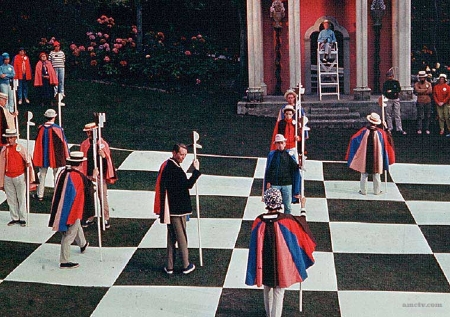
Like putting together a 200 piece puzzle of M.C. Escher’s staircase, the plot unfolds to reveal its splendid complexity. The colourful clothing of the townspeople is in stark contrast to their drab personalities and strict adherence to rules of conformity enforced by the establishment. Upon deeper inspection, the wardrobe, towels, and umbrellas of the townsfolk are in primary colours; blue, red, green, yellow, the same shades recur with no variation. Number Six has a distinctly different outfit: gray pants, dark blue turtleneck, and black dress jacket with white trim. Nobody looks like him, and nobody dares act like him. He is the embodiment of non-conformity: he questions the rules of the authorities, and tries to escape every chance he gets.
The location of the exterior shots is a visual odyssey in its own right. The village is cluster of breath-taking classically inspired buildings surrounded on three sides by mountains and a beach by the sea on the forth. The location was carefully kept secret during production, finally revealed in the closing credits of the last episode, “Fall Out.” Portmeirion, a small resort town in North Wales, has an enchanting quality about it. A vanity project by Welsh architect, Sir Clough Williams-Ellis, it was deigned and constructed between 1925 and 1975 in the style of a southern Italian town. Lovely sunny days, lush gardens, and palm trees make this town idyllic, but it is a gilded cage for Number 6.
The art Director, Jack Shampan, created the atmospheric Bond-like feel to the mechanical devices and interiors of Number 2s chamber and dome control room. Rover is huge remote control white bouncing balloon which incapacitates in-subordinates and escapes. When it moves through the village, people become motionless; a surreal sight.
“The Prisoner” is experimental in theme, characters, and setting. Like the work of Lewis Carroll, it combines symbolism, strange characters, and unusual scenarios to weave together a story which represents different things for different people. McGoohan was offered the role of Bond before Roger Moore, but he reclined on the grounds that he wished his character to use his mind instead of a gun (just like Doctor Who). He chose instead to take the spy genre to heretofore unexplored psychological and sociological territory and for that we are forever grateful.
“The Prisoner” presented us with an absurdist existence in a mysterious village. The villagers are absurdist in their dress, anti-individual stance, and blind devotion to an invisible authority. Number Six is a stranger in a strange place, but in a deeper philosophical sense. The show played with bizarre camera angles and unusual visuals to convey such effects as disorientation, psychedelic drugs, confusion, and dream-states. The main character is novel to television: a militant non-conformist who openly questions societal rules and refuses to “fit in.
The time has come to stand up as individuals against social injustices. The 99% movement, Occupy Wall St, and global protests embody the spirit of McGoohans legacy, which is both profound and timely. Doctor Who, Number 6, V (V for Vendetta) and now we proclaim that you can't kill an idea.
"I am not a number, I am a free man" speech from The Prisoner...Relevant more now than ever!
Wonderful homage to Patrick McGoohan (part 1 of 3)
“Mrs. Peel - We’re Needed”
“The Avengers” is an outstanding BBC spy-fi (spy fiction with elements of science fiction) adventure series starring Patrick Macnee (1922 – present) as the impeccably stylish secret agent John Steed, and Dame Diana Rigg (1938 – present) as the fearless and independent-minded Emma Peel. The show ran from 1961 – 1969 and was filmed in black and white until 1967, when colour was introduced to marvelous effect. Rigg played Peel from 1965 – 1968, after Honor Blackman, who played Catherine Gale, left the show.
Peel is the epitome of femininity; intelligent, elegant, and beautiful, all while fighting off enemy spies so she can complete a friendly game of chess with Steed. Her classic Lotus Elan sports car and leather cat suits embody the ideal of an emancipated modern woman.
Steed is the quintessential British upper-class gentleman-spy: he wears a smart suit (designed by Pierre Cardin), carries a concealed sword in his umbrella, and has a custom metal bowler hat (for fighting, of course). Suave, sophisticated, full of gadgets and witty one-liners, Steed is televisions version of James Bond, minus the regular visits to the STD clinic. Steed and Peel never kiss but occasionally flirt. They complement each other perfectly as they fight international espionage plots and still have time left over to pop open a vintage bottle of champagne at the end of each episode.
The playful Mod clothing and extraordinary set design establish the unique visual character of the series. Framed photographs of eyes on walls, round-shaped brightly coloured furniture, and big-buttoned A-line jackets blend with walking bass lines and beatnik drums to create a collage of the swinging 60s. Peels dynamic and bold-coloured Mod garb was designed by Alun Hughes.
The titles of the episodes are as whimsical as the show, spoofing titles of films and television shows. For example: “The Girl from AUNTIE” spoofs of spy-fi show, “The Man from U.N.C.L.E.,” “Mission Highly Improbable” lampoons secret agent show “Mission Impossible,” and “A Funny Thing Happened on the Way to the Station” parody’s “A Funny Thing Happened on the Way to the Forum,” 1966 film comedy with Buster Keaton in his last film appearance).
“The Joker” (season 5 episode 15, 1967)
In which Steed trumps an ace –
And Emma plays a lone card
Pendergast, a criminal whom Peel had sent to jail, has devised a scheme to lure her to an isolated mansion in the countryside. She arrives at the Victorian-Gothic style manor expecting to spend the weekend playing bridge, but instead finds Ola, a menacing young woman who tells her that the host has been delayed and will arrive later. The mansion is reminiscent of those found in Hammer horror films (a la Vincent Price) with its wood paneling, antique furniture, and candelabras. The eight-foot tall playing cards throughout the dinning room and one as a revolving door on top of the staircase break the horror film spell and become absurdist. After Ola leaves to “care for a sick friend,” Peel can tell she isn’t alone in the house when the card door keeps revolving.
Far be it for Peel to be intimidated. A stranger appears at the door asking to use the phone instead he takes his knife out and asks, “How would you like me to tuck you in (to bed)?” She twists his arm and says, “How would you like me to break your arm?” as she kicks him out the door.
The attention to detail in the application of colour in this episode is dazzling. Peels Chinese red silk pajamas make her shoulder-length auburn hair radiate. The tablecloth and the wall paper in the dinning room are the same shade of red as hearts on the cards and the roses Pentergast leaves around the house for Peel to find. Ola wears a sweater which is the identical blue to that of the candles and the clothing on the cards.
The gramophone record which Pentergast plays repeatedly in order to taunt Peel is a German song called, “Mein Liebling, Mein Rose.” The producers could have gone through the trouble to find someone who could sing it with proper German grammar and without the fake accent. The correct title should have been, “Mein Liebing, Meine Rose.” There were a few parts in the song which had flawed grammar.
“The Avengers” has classic wit and charisma which makes it addictive. The chemistry between Steed and Peel clicks perfectly. Peel pioneered the role of strong female characters. In the mid-sixties, it was unprecedented to have a woman who could fight (and win) her own battles. Female roles were weak and mousy; they often were victims who would get kidnapped by just grabbing their wrists and walking away. We didn’t get another tough and robust female role like that until 1977 with Princess Leia from “Star Wars.” After Leia, it took at least another decade for resilient females to become visible. The proliferation of these women, such as Trinity from “The Matrix” (1999), can be traced back to the immaculate Emma Peel.
The Absurdist World of Ernie Kovacs
What Emerges from Three Peas in a Pod
These are three influential shows from the sixties, each different, yet similar. Their similarity lies in what they utilized and contributed to the future of film and television.
“The Avengers” gives us Emma Peel, who rebels against the accepted norm of female behaviour. She thinks for herself and does for herself; she is her own person. The Art Direction is one-of-a-kind: vibrantly coloured sets, absurd props with absurd plots (like Peel being tied to the mini railroad track as the train approaches) seem cartoon-like (in a good way)..
The shows use of lighting, camera effects and odd props generates a feeling that this can’t be real. Is it all a dream?
~~~~~~~~~~~~~~~~~~~~~~~~~~~~~~~~~~~~~~~~~~~~~~~~~~~~~~~~~~~~~~~~~~~~~~~~
STRANGE INTERLUDE: My Dream, Time-Travel inspired band, "Hypnagogic Telegram" is going VIRAL on Youtube. Timelord Rock.Trock. I play a timeghost (zeitgeist) that inhabits the wardrobe closet in the TARDIS. I come out in costumes from various eras to dance & sing. If Doctor Who would have a band, it might sound like this.
<---- View YOUTUBE VIDEO here.
On FACEBOOK @ HYPNAGOGIC TELEGRAM
Check out my Time Travel, Dream, surreal artwork, performance art, costuming & photography on the other blog pages!