Showing posts with label BBC. Show all posts

Friday, April 19, 2013

„Šerlokas“ (Benedict Cumberbatch "Sherlock" BBC) pirmoji serija ant LRT Televizija Lietuvoje, ir Rusiškas Šerlokas Holmsas (Vasily Livanov)

http://pramogos.delfi.lt/eteris/geriausias-musu-laiku-detektyvas-serlokas-sekmadienio-vakarais-per-lrt.d?id=59887509

Ekscentrikas Šerlokas Holmsas (Benedict Cumberbatch) suo 

Džonu Votsonu (Martin Freeman) ant 

Lietuviska Televizija
.

Arthuro Conano Doyle‘o knyga darba suo technologija ir internetuo. 

Misis Hadson, Meifroftas, Moriartis, ir visi kiti.

Suo Benedict Cumberbatch ("Benedictas Cumberbatchas" in Lithuanian), Martin Freeman (Martinas Freemanas), Mark Gatiss (Markis Gatiss...his last name already sounds Lithuanian, LOL), et al.

Season one 2009 season 10 2010 
UK produced, won dozens of awards, 9 million viewers in the UK
DVD sold in 180 countries worldwide,
yet still virtually unknown in America. Aired on PBS (Public Broadcasting Station) in the United States.

blog by DainaSurrealsm, Lithuanian surrealist artist, musician, performance artist in Chicago

Benedict Cumberbatch was now #1 on IMDb top actor list during run of Star Trek Into Darkness.
Please vote on my Cumberhair survey. It's anonymous, and you get to view statistics after you're done! 


In this new adaptation of the classic, the Sherlock character is transposed from Victorian England to the modern era. He uses the modern technology of our time, such as the Internet and cell phones, in order to solve crime mysteries. Stephen Moffat (best known as main writer of "Dr. who") co-created "Sherlock" with Mark Gatiss (writer of "Dr. Who," and plays Lazarus in "Dr Who: the Lazarus Experiment") did a commendable job of storytelling in this novel concept of a modern-day Sherlock Holmes. 

Benedict Cumberbatch is an impeccable actor regardless which role he plays, and he is especially talented as Sherlock. Susanna White, director of Parade's End" (BBC drama), called Cumberbatch "one of the finest actors of his generation." He does a brilliant job of portraying the genius of Sherlock who is socially awkward with an abrasive, yet, comical and witty character.

The tension and excitement is highly entertaining in each of the six episodes. The humour is dry with a heavy dose of classic British absurdity reminiscent of "Harry Potter." This sort of absurdist humour has a history that spans from Lewis Carroll's classic book "Alice in Wonderland" to Edward Lear's limericks, to "Monty Python" and "Black Adder." It's like to keep a straight face of this kind of silliness going on!

An example of the classic absurdist British humor, Sherlock's wits, and his unconventional methods of deduction skills can be witnessed in the scene when he comes home to find intruders that have broken in and all holding his landlady, Mrs. Hudson, hostage.


Sherlock and Watson (played wonderfully by Martin Freeman) have a love-hate relationship going on with each other. Sherlock insults Watson calling him and others around him simpleminded because they fail to see what is "so obvious" to Sherlock. Watson alternates between amazment of Sherlock's mental abilities and annoyance of his blatant disregard for manners and social conventions.


This series is unusual in another way as well: each episode is 90 minutes long, each season has three episodes, thus making the individual episodes feel more like a film than the TV show.

Season 3 is currently in production, with the first episode "the Empty Hearse" having just completed film on 15th of April.

The show combines ingenious and seamless editing and creative camera angles which to April job of showing the world shall lot eyes which was not present, to the best of my knowledge, on previous incarnations of Sherlock on film.

Innovative camera techniques, such as the introduction of the show being shot in "Tilt Shift" also known as "Tiny Town" technique which was developed by a German filmmaker in Berlin. This method, which utilizes a focus on the centre of the frame whilst leaving the rest of the objects in frame slightly out of focus, creates the effect of making the London cityscape looked like toy model city with mechanical moving parts (trains, cars, people, etc). Here is the intro...

And this is the way Berlin looks using the same technique....


Note that  the camera technique utilized in "Sherlock" Vatican Cameos scene was using Phantom cameras (by Vision Research Cameras). These super high speed cameras are a cinematographer's dream. They shoot at four different speeds:

554 frames per second at 2000 p Resolution
1050 FPS at 1080 p
1500 FPS at 720 p
2351 FPS at 480 p


They used this in the "Vatican Cameos" scene in "A Scandal in Belgravia" (season 2 episode 1), which is shown below...

Here is wonderful example of how this camera captures slow motion w/ actor Alan Rickman at normal speed (11 seconds) and slow motion (7 mins). Amazing!

By the way, http://www.sherlockology.com/ (the Ultimate Guide for any Sherlock fan) is a splendid site for all things Sherlock, from info on clothes, props, episodes, shopping, behind-the-scenes, news, downloads, etc.
 
Season 3 hints from the creators of "Sherlock" 
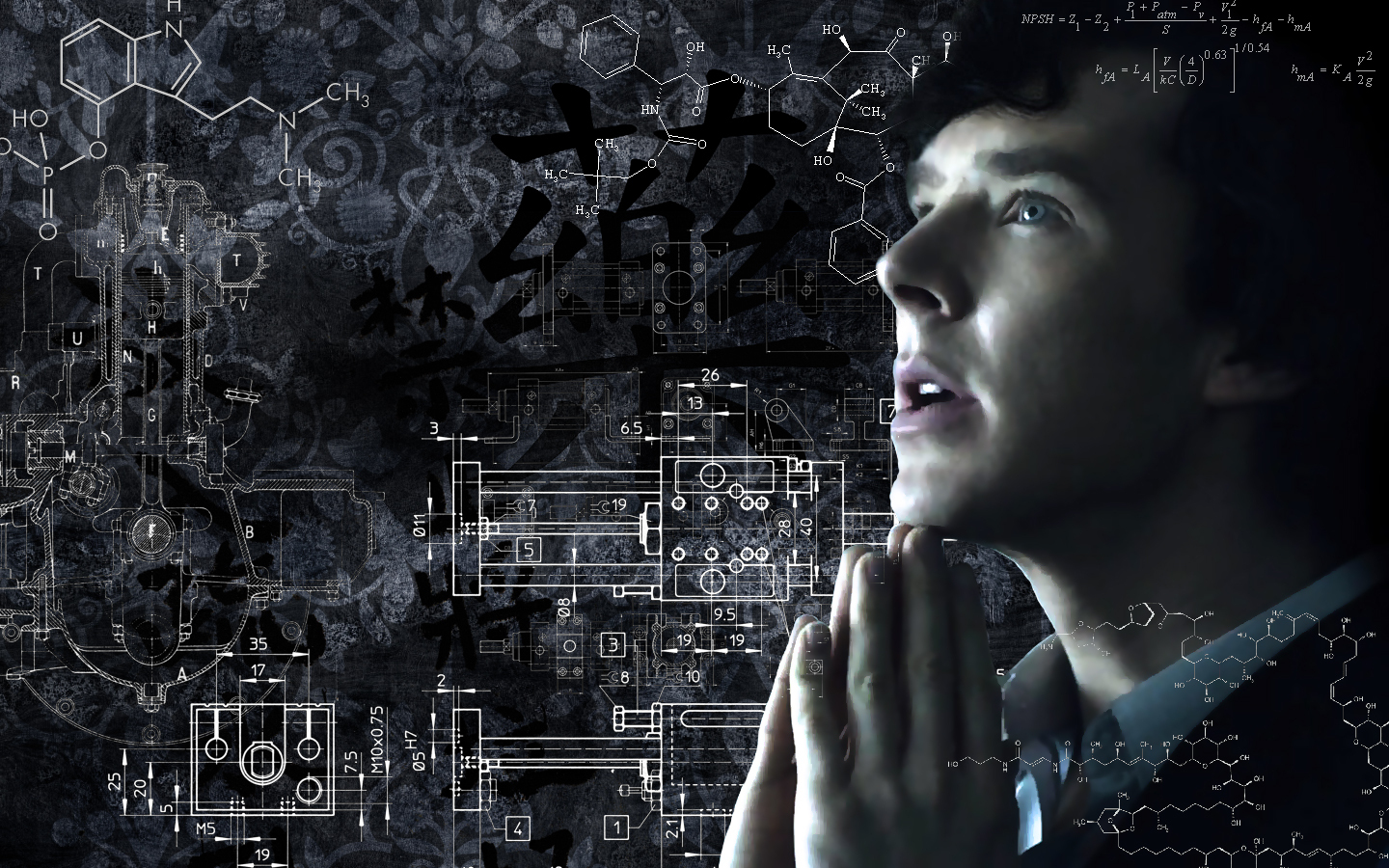
~~~~~~~~~~~~~~~~~~~~~~~~~~~~~~~~~~~~~~~~~~~~~~~~~~~~~~~~~~~~~~~~~~~~~~~~~~~~~~~~~~If there are any videos in Lithuanian, please let me know in the comments. I'd be more than happy to post them!

"Sherlock" in 5 languages: English, Italian, Russian, Spanish, French (below)


"Sherlock" blanket rants in 4 languages: English, French, Russian, Spanish (below)


"Sherlock" in 6 languages: English, French, German, Italian, Russian, Spanish (below)


Nice review of Lithuanian "Sherlock" in Lithuanian
http://www.pinigukarta.lt/apzvalgos/tv-serialai/serlokas

Guinese Book of world records states that Sherlock Holmes is the most often played iconic character in film. 211 films and 75 actors who played him. The first portrayal on film being back in 1900.

Guinesso rekordų knyga tai padarė už mus – Šerlokas Holmsas yra labiausiai ekranizuotas personažas, 211 filmų jį vaidino 75 aktoriai, o pirmasis pasirodymas įvyko jau 1900 metais.
~~~~~~~~~~~~~~~~~~~~~~~~~~~~~~~~~~~~~~~~~~~~~~~~~~~~~~~~~~~~~~~~~~~~~~~~Found a lovely Tumblr on Lithuanian "Sherlock" and how it's received in Lithuania (below). This ties in well with my "What its-Really like Knowing Someone Famous" blog, which apologizes about excessive and obsessive fandom, as opposed to viewing fandom from a different perspective.
http://www.tumblr.com/tagged/%C5%A0erlokas


~~~~~~~~~~~~~~~~~~~~~~~~~~~~~~~~~~~~~~~~~~~~~~~~~~~~~~~~~~~~~~~~~~~~~~~~

„Šerloko Holmso nuotykiai“ (The Adventures of Sherlock Holmes) w/Jeremy Brett on Lithuanian TV

~~~~~~~~~~~~~~~~~~~~~~~~~~~~~~~~~~~~~~~~~~~~~~~~~~~~~~~~~~~~~~~~~~~~~~~~

Rusiškas Šerlokas Holmsas švenčia jubiliejų (suoVasili Livanov) http://zebra.15min.lt/lt/mokslas_it/mokslas/rusiskas-serlokas-holmsas-svencia-jubilieju-207314.html#gallery 


~~~~~~~~~~~~~~~~~~~~~~~~~~~~~~~~~~~~~~~~~~~~~~~~~~~~~~~~~~~~~~~~~~~~~~~~

Lithuanian wikipedia entry on Sherlock Holmes (the character) "Šerlokas Holmsas"
http://lt.wikipedia.org/wiki/%C5%A0erlokas_Holmsas


~~~~~~~~~~~~~~~~~~~~~~~~~~~~~~~~~~~~~~~~~~~~~~~~~~~~~~~~~~~~~~~~~~~~~~~~
STRANGE INTERLUDE: My Dream, Time-Travel inspired band, "Hypnagogic Telegram" is going VIRAL on Youtube. Timelord Rock. Trock. I play literal personification of a ZeitGeist (TimeGhost) that inhabits the wardrobe closet in the TARDIS. I come out in costumes from various eras to dance & sing in various languages (Lithuanian. French, German, Russian, English) . If Doctor Who would have a band, it might sound like this.
<---- View YOUTUBE VIDEO here.
On FACEBOOK @ HYPNAGOGIC TELEGRAM

Check out my Time Travel, Dream, surreal artwork, performance art, costuming & photography on the other blog pages!


Tuesday, March 26, 2013

Surrealist Game to Cast Doctor Who using Time Travel. Who would you choose?


Emerging from an hypnopompic state, the transition phase between sleep and wakefulness, the following thought entered my mind: "what kind of surrealist are you if you don't go back in time and cast actors from the history of filmmaking in the role of Doctor Who?" I woke up thinking, "what a brilliantly mad idea!"

So here I am, in a semi-drowsy state (for I do not drink coffee and therefore transition slowly from dream to reality) asking you to expand your imagination and play this surrealist game with me.
Any actor from the history of filmmaking, including the silent era, from within the English-speaking world. This includes male, female, gender non-conformist, intersex actors. Capt. Jack Harkness said it best, "You people and your quaint little categories."

~~~~~~~~~~~~~~~~~~~~~~~~~~~~~~~~~~~~~~~~~~~~~~~~~~~~~~~~~~~~~~~~~~~~~~~~
This is my subconscious doing a variation of the surrealist game "Time Travelers' Potlatch," Which is described as follows on the Chicago Surrealist Group website.

"In Time-Travelers' Potlatch, each player indicates the gift that she/he would present to various historical, mythical, or fictional figures on the occasion of their meeting. The game introduces the object into an imaginary relationship that otherwise tends to be
defined too superficially by an arbitrary and abstract subjectivity. The object—the gift—functions symbolically between the giver (the player, who lives in the present) and the receiver (who dwells in the past, or on another plane of existence). Altering the relationship between the two, the imagined gift constitutes a third term: a catalyst of the future in the form of a crystallization of desire.Thus the game opens a new approach, from an unanticipated angle, to all the old and unresolved problems of projection, identification, idealization, fixation, obsession, etc." http://www.surrealistmovement-usa.org/pages/time.html *

You are invited to leave comments as to which actors from the past you would wish to cast. Imagine if you will, that you have a TARDIS and can go back to any era in film history and pick the actors of your choice. Envision a parallel universe, converging timelines, etc. You can transport these actors to our time or cast them in their own era.

I will start by casting my characters.


My first vote is for Emma Peel in a parallel universe where she is a real-life person instead of character in a fictional show ("The Avengers"). Or perhaps a crossover between "The Avengers" and "Doctor Who" in which Emma Peel stands between John Steed and Tara King on the sidewalk just outside Steed's flat. She takes her leave from him by saying, "I must be off: I am being summoned back to Gallifrey." She gives him a kiss on the cheek and tells Tara, "he likes his tea stirred counterclockwise," as she raises her right hand to twirl her index finger in an imaginary teacup. "Be seeing you," she says, and makes her characteristically graceful 180° turn as her thigh length Mod coat mushrooms up around her. She then walks briskly toward the police box on the corner across the street and to the right of Steed's front door. She unlocks the door, steps inside, peeking out one last time to wave goodbye. Seconds later the door closes: Steed and Tara give each other a puzzled look as the TARDIS disappears. He turns to Tara and asks, "champagne?" to which she replies, "I'd love some." He opens his front door and with a bow gestures his arm, "Ladies first," he says with a smile. Fade shot. This is how Emma Peel returns to her life as a Timelord. To be continued?


Who's next? Patrick McGoohan is a fine candidate. His anarchic quality combined with his ability to stare down any foe would make him an excellent choice for the role of the Doctor. His defiance would be formidable. Imagine him confronting a Dalek: you could cut the tension with a knife!
McGoohan is sadly no longer with us, having died in 2009, but he left us the legacy of his work. He played many roles in many memorable films, from "Ice Station Zebra" (1968) to "Braveheart" (1995). He worked in both film and television, his most memorable role being that of Number Six in the iconic, anti-authoritarian TV series "The Prisoner" (1967 - 68). He turned down the role of James Bond in order to produce, star and direct this most brilliant, original and outstanding production in the history of television. And for that we think him. See my review of "The Prisoner" http://dainasurrealism.blogspot.com/2011/05/ground-breaking-cult-television-shows.html


Like many Dr Who fans, I've been thinking lately about the fact that Matt Smith has been playing the Doctor for 3 years now and he may leave soon. Benedict Cumberbatch, who plays the title character in BBCs "Sherlock," has been voted by fans as a candidate for the next Doctor. Benedict-Cumberbatch-wins-Sun-poll-for-new-Doctor-Who

More characters to be added later. Who knows, they may come to me in a dream...

Check out my Time Travel, Dream, surreal artwork, performance art, costuming & photography on the other blog pages!

I had a dream that Mark Gatiss (script writer to Doctor Who and Sherlock) bought me a lovely fountain pen. My subconscious is telling me to write more. Dream, March, 22, 2013


* http://www.surrealistmovement-usa.org/pages/time.html This link also has an Exquisite Corpse game which I collaborated on with other Surrealists. Both games are published in the book

"Surrealist Subversions: Rants, Writings & Images by the Surrealist Movement in the United States"

 http://www.amazon.com/Surrealist-Subversions-Writings-Movement-Autonomedia/dp/1570271224/ref=sr_1_1?ie=UTF8&qid=1364355724&sr=8-1&keywords=surrealist+subversions
~~~~~~~~~~~~~~~~~~~~~~~~~~~~~~~~~~~~~~~~~~~~~~~~~~~~~~~~~~~~~~~~~~~~~~~~
STRANGE INTERLUDE: My Dream, Time-Travel inspired band, "Hypnagogic Telegram" is going VIRAL on Youtube. Timelord Rock. Trock. I play a spirit that inhabits the wardrobe closet in the TARDIS. I come out in costumes from various eras to dance & sing. If Doctor Who would have a band, it might sound like this.
<---- View YOUTUBE VIDEO here.
On FACEBOOK @ HYPNAGOGIC TELEGRAM


Tuesday, May 3, 2011

THE PRISONER w/ Patrick McGoohan (Ground-breaking Cult Television Shows of the 1960s pt 1)

The 1960s was a time of questioning the status quo and exploring new forms of creative expression. Three shows from this era stand out for their innovative visual effects, controversial main characters, and absurdist plots; “The Prisoner,” “The Avengers,’ and “The Ernie Kovacs Show.” They continue to influence film and television to this day.


“I am not a Number, I am a Free Man”


The legendary British mini-series, “The Prisoner” (1967) stars Patrick McGoohan (1928 – 2009) as Number Six, a kidnapped ex-spy who is relocated to a beautiful yet mysterious village where the inhabitants are known not by their names, but by their assigned numbers. McGoohan (King Edward I in “Braveheart” 1995) was the brilliantly creative mind behind the show; having written, produced, and directed it.

The intro to the show sets the stage superbly, thus making each of the seventeen episodes non-linear. To the sound of thunder, Number Six storms into his Bose’s office with a letter of resignation. A menacingly large black car follows him home, looking as if it will eat his small Lotus sports car with him in it. He hurriedly packs his suitcase, only to be gassed through a keyhole. Disoriented, he wakes up and stumbles to a window to find he is in an apartment in the Village.

Number 6 asks: “Where am I?”/ Number 2: “In the Village.”/ “What do you want?”/ “We want information.”/ “Whose side are you on?”/ “That would be telling. We want information.”/ “You won’t get it!”/ “By hook or by crook, we will!”/ “Who are you?”/ “The new Number 2.” / “Who is Number 1?” / “You are Number 6.” / “I am not a Number, I am a Free Man!” / Number 2 laughs heartily (fade)


What is the reason why Number 6 resigned in such a fury? What is the nature of the information which Number 2 is obsessed with obtaining? Where is this Village? The answer is: there is no answer. That is the exquisiteness of the show; it is purposefully left open to the interpretation of its viewers. This is no mindless sit-com with canned laughter tracks signaling viewers where to giggle; it is a thinking persons program full of symbolism, social criticism, and double entendres.

McGoohan’s vision of a Kafkaesque society where untold numbers of people are blackmailed to report on the activity of others is hauntingly familiar to that of the Stasi (Secret Police) apparatus in East Germany which indoctrinated one quarter of the population to spy on their friends, family, and neighbours. The show is timeless and produces striking images which permanently etch themselves into the minds of viewers.

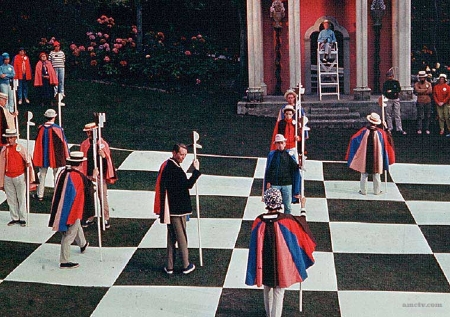
Like putting together a 200 piece puzzle of M.C. Escher’s staircase, the plot unfolds to reveal its splendid complexity. The colourful clothing of the townspeople is in stark contrast to their drab personalities and strict adherence to rules of conformity enforced by the establishment. Upon deeper inspection, the wardrobe, towels, and umbrellas of the townsfolk are in primary colours; blue, red, green, yellow, the same shades recur with no variation. Number Six has a distinctly different outfit: gray pants, dark blue turtleneck, and black dress jacket with white trim. Nobody looks like him, and nobody dares act like him. He is the embodiment of non-conformity: he questions the rules of the authorities, and tries to escape every chance he gets.

The location of the exterior shots is a visual odyssey in its own right. The village is cluster of breath-taking classically inspired buildings surrounded on three sides by mountains and a beach by the sea on the forth. The location was carefully kept secret during production, finally revealed in the closing credits of the last episode, “Fall Out.” Portmeirion, a small resort town in North Wales, has an enchanting quality about it. A vanity project by Welsh architect, Sir Clough Williams-Ellis, it was deigned and constructed between 1925 and 1975 in the style of a southern Italian town. Lovely sunny days, lush gardens, and palm trees make this town idyllic, but it is a gilded cage for Number 6.

The art Director, Jack Shampan, created the atmospheric Bond-like feel to the mechanical devices and interiors of Number 2s chamber and dome control room. Rover is huge remote control white bouncing balloon which incapacitates in-subordinates and escapes. When it moves through the village, people become motionless; a surreal sight.

“The Prisoner” is experimental in theme, characters, and setting. Like the work of Lewis Carroll, it combines symbolism, strange characters, and unusual scenarios to weave together a story which represents different things for different people. McGoohan was offered the role of Bond before Roger Moore, but he reclined on the grounds that he wished his character to use his mind instead of a gun (just like Doctor Who). He chose instead to take the spy genre to heretofore unexplored psychological and sociological territory and for that we are forever grateful.

“The Prisoner” presented us with an absurdist existence in a mysterious village. The villagers are absurdist in their dress, anti-individual stance, and blind devotion to an invisible authority. Number Six is a stranger in a strange place, but in a deeper philosophical sense. The show played with bizarre camera angles and unusual visuals to convey such effects as disorientation, psychedelic drugs, confusion, and dream-states. The main character is novel to television: a militant non-conformist who openly questions societal rules and refuses to “fit in.
The time has come to stand up as individuals against social injustices. The 99% movement, Occupy Wall St, and global protests embody the spirit of McGoohans legacy, which is both profound and timely. Doctor Who, Number 6, V (V for Vendetta) and now we proclaim that you can't kill an idea.


"I am not a number, I am a free man" speech from The Prisoner...Relevant more now than ever!


Wonderful homage to Patrick McGoohan (part 1 of 3)


“Mrs. Peel - We’re Needed”


“The Avengers” is an outstanding BBC spy-fi (spy fiction with elements of science fiction) adventure series starring Patrick Macnee (1922 – present) as the impeccably stylish secret agent John Steed, and Dame Diana Rigg (1938 – present) as the fearless and independent-minded Emma Peel. The show ran from 1961 – 1969 and was filmed in black and white until 1967, when colour was introduced to marvelous effect. Rigg played Peel from 1965 – 1968, after Honor Blackman, who played Catherine Gale, left the show.

Peel is the epitome of femininity; intelligent, elegant, and beautiful, all while fighting off enemy spies so she can complete a friendly game of chess with Steed. Her classic Lotus Elan sports car and leather cat suits embody the ideal of an emancipated modern woman.

Steed is the quintessential British upper-class gentleman-spy: he wears a smart suit (designed by Pierre Cardin), carries a concealed sword in his umbrella, and has a custom metal bowler hat (for fighting, of course). Suave, sophisticated, full of gadgets and witty one-liners, Steed is televisions version of James Bond, minus the regular visits to the STD clinic. Steed and Peel never kiss but occasionally flirt. They complement each other perfectly as they fight international espionage plots and still have time left over to pop open a vintage bottle of champagne at the end of each episode.

The playful Mod clothing and extraordinary set design establish the unique visual character of the series. Framed photographs of eyes on walls, round-shaped brightly coloured furniture, and big-buttoned A-line jackets blend with walking bass lines and beatnik drums to create a collage of the swinging 60s. Peels dynamic and bold-coloured Mod garb was designed by Alun Hughes.

The titles of the episodes are as whimsical as the show, spoofing titles of films and television shows. For example: “The Girl from AUNTIE” spoofs of spy-fi show, “The Man from U.N.C.L.E.,” “Mission Highly Improbable” lampoons secret agent show “Mission Impossible,” and “A Funny Thing Happened on the Way to the Station” parody’s “A Funny Thing Happened on the Way to the Forum,” 1966 film comedy with Buster Keaton in his last film appearance).


“The Joker” (season 5 episode 15, 1967)

In which Steed trumps an ace –

And Emma plays a lone card


Pendergast, a criminal whom Peel had sent to jail, has devised a scheme to lure her to an isolated mansion in the countryside. She arrives at the Victorian-Gothic style manor expecting to spend the weekend playing bridge, but instead finds Ola, a menacing young woman who tells her that the host has been delayed and will arrive later. The mansion is reminiscent of those found in Hammer horror films (a la Vincent Price) with its wood paneling, antique furniture, and candelabras. The eight-foot tall playing cards throughout the dinning room and one as a revolving door on top of the staircase break the horror film spell and become absurdist. After Ola leaves to “care for a sick friend,” Peel can tell she isn’t alone in the house when the card door keeps revolving.

Far be it for Peel to be intimidated. A stranger appears at the door asking to use the phone instead he takes his knife out and asks, “How would you like me to tuck you in (to bed)?” She twists his arm and says, “How would you like me to break your arm?” as she kicks him out the door.

The attention to detail in the application of colour in this episode is dazzling. Peels Chinese red silk pajamas make her shoulder-length auburn hair radiate. The tablecloth and the wall paper in the dinning room are the same shade of red as hearts on the cards and the roses Pentergast leaves around the house for Peel to find. Ola wears a sweater which is the identical blue to that of the candles and the clothing on the cards.

The gramophone record which Pentergast plays repeatedly in order to taunt Peel is a German song called, “Mein Liebling, Mein Rose.” The producers could have gone through the trouble to find someone who could sing it with proper German grammar and without the fake accent. The correct title should have been, “Mein Liebing, Meine Rose.” There were a few parts in the song which had flawed grammar.

“The Avengers” has classic wit and charisma which makes it addictive. The chemistry between Steed and Peel clicks perfectly. Peel pioneered the role of strong female characters. In the mid-sixties, it was unprecedented to have a woman who could fight (and win) her own battles. Female roles were weak and mousy; they often were victims who would get kidnapped by just grabbing their wrists and walking away. We didn’t get another tough and robust female role like that until 1977 with Princess Leia from “Star Wars.” After Leia, it took at least another decade for resilient females to become visible. The proliferation of these women, such as Trinity from “The Matrix” (1999), can be traced back to the immaculate Emma Peel.


The Absurdist World of Ernie Kovacs


What Emerges from Three Peas in a Pod


These are three influential shows from the sixties, each different, yet similar. Their similarity lies in what they utilized and contributed to the future of film and television.

“The Avengers” gives us Emma Peel, who rebels against the accepted norm of female behaviour. She thinks for herself and does for herself; she is her own person. The Art Direction is one-of-a-kind: vibrantly coloured sets, absurd props with absurd plots (like Peel being tied to the mini railroad track as the train approaches) seem cartoon-like (in a good way)..

The shows use of lighting, camera effects and odd props generates a feeling that this can’t be real. Is it all a dream?
~~~~~~~~~~~~~~~~~~~~~~~~~~~~~~~~~~~~~~~~~~~~~~~~~~~~~~~~~~~~~~~~~~~~~~~~

STRANGE INTERLUDE: My Dream, Time-Travel inspired band, "Hypnagogic Telegram" is going VIRAL on Youtube. Timelord Rock. Trock. I play a timeghost (zeitgeist) that inhabits the wardrobe closet in the TARDIS. I come out in costumes from various eras to dance & sing. If Doctor Who would have a band, it might sound like this.
<---- View YOUTUBE VIDEO here.
On FACEBOOK @ HYPNAGOGIC TELEGRAM

Check out my Time Travel, Dream, surreal artwork, performance art, costuming & photography on the other blog pages!



Total Pageviews

Translate

Pages

Search This Blog