It’s hard to select three great shows from first decades of TV. There is certainly a wide selection: “The Burns and Allen Show,” “Monty Python’s Flying Circus,” “Alfred Hitchcock Presents,” “Doctor Who,” “The Saint” and “Twilight Zone.” Experimental shows such as “The Prisoner,” “The Avengers,” and “The Ernie Kovacs Show” are outstanding examples of experimentation and creative vision. Their influences are seen in books, films, and tv shows to this day (to be discussed further in body of essay).
“The Prisoner” is a spy fiction cult show which ran for 17 episodes from 1967 – 1968. Its mysterious setting, a small town in Wales with lovely yet unusual architecture, and the Kafkaesque struggle of the main character, Number 6, provides the setting for a psychological thriller with surreal and countercultural themes.
“The Avengers” (1961 – 1969) presents us with two secret agents, Emma Peel, and John Steed, a boiler wearing gentleman who’s always ready for a fight (as long as it’s dignified). The show is visually striking with superbly colourful art direction. The British tongue-in-cheek humour makes the chemistry between Peel and Steed sparkle. There is a comic-book quality to the plots. Strange villains and a sprinkle of silliness create a unique tv experience.
“The Ernie Kovacs Show” (1952 – 1956) features the eccentric ad-lib comedy and innovative video effects of Kovacs (1919 – 1962). His characters and visual gags influenced Monty Python, David Letterman, and various comedians on “Saturday Night Live.” “The Ernie Kovacs Collection,” a six DVD box-set of his various TV shows has just been released April 19.
Tuesday, April 19, 2011

Tuesday, April 12, 2011
Animaniacs: Mashup of Warner Brothers and Marx Brothers
Animaniacs is a Warner Brothers animated series which ran for five seasons from 1993 – 1998. MAJOR NEWS: Classic episodes of Animaniacs is now being shown on The Hub Mon - Thurs 7pm EST, 4pm PST! Executive producer Steven Spielberg and senior producer/writer Tom Ruegger present us with a mad-cap comedy in classic Looney Toons style with running gags, visual puns, side-splitting lyrics, spoofs of films and TV shows, and parodies of celebrities, politicians, and historical figures. Homages to classic films and cameos of celebrities, especially from the Golden Age of Hollywood, are to be found around every bend. The main characters are the Warner brothers, Yakko and Wakko, and their sister, Dot. They have cat-like tails, black fur; wear white gloves, have white feet and white faces. One of the recurrent gags is that none of the other characters can figure out what species they are. They in turn revel at keeping everyone guessing.
 ~~~~~~~~~~~~~~~~~~~~~~~~~~~~~~~~~~~~~~~~~~~~~~~~~~~~~~~~~~~~~~~~~~~~~~~
Strange Interlude: SURREALIST NEWS: HYPNAGOGIC TELEGRAM (my band) is GOING VIRAL w/ Chaplin dance. New album out soon. New videos, incl How to Remember Dreams (surrealist tips) & songs soon on YOUTUBE. Here is us doing CHAPLIN DANCE to backdrop of George Melies 1902 film Trip to the Moon (as seen in Hugo film)
Lewis Carroll, Dr Who, Dream, & Fortean inpired tunes. Multi-lingual. Silent film inspired dances. Trock. Lietuvaite soka kaip Chaplin.
~~~~~~~~~~~~~~~~~~~~~~~~~~~~~~~~~~~~~~~~~~~~~~~~~~~~~~~~~~~~~~~~~~~~~
The first episode opens with the back-story in black & white with Yakko’s, Wakko’s and Dot’s red noses being the only colour in the sequence. It starts with a four-way split screen of the Phantom of the Opera, Harold Lloyd hanging from a clock, Buster Keaton chashed by a train, and Charlie Chaplin eating his shoe. “Newsreel of the Stars, dateline: Hollywood, 1930,” the announcer proclaims. He informs us how the Warner Brothers Animation Studio created the siblings not knowing what they got themselves into. Yakko, Wakko and Dot caused havoc on the set and their films made no sense making the studio execs cringe. As a consequence, their films were locked away in the studio vault and the siblings were locked away in the studio water tower “never to be released.” They broke out of their confinement, and that’s the way the adventures begin.
Supporting characters include Pinky, a thin dim-witted lab mouse with an Australian accent, and Brain, the megalomaniacal evil genius whose plans to “take over the world” are foiled by Pinky’s blundering. Slappy Squirrel is grumpy and cheeky old former cartoon star “from the god old days” with hilarious one-liners. In “Woodstock Slappy” (Season 1, episode 281), Slappy and her nephew, Skippy, go to the country for some relaxation only to wake up and find that their tree is in the middle of the audience to Woodstock. They jump up on an amp and do a witty homage to Abbott and Costello’s “Who’s on First.” Slappy asks Skippy, “What’s the name of the group playing on stage?”
Skippy: “Who,”
Slappy: “They name of the group on stage.”
Skippy:“Who”
Slappy: “Who is on stage?”
Skippy: “Yes”
Slappy: “So the name of the band is Yes?”
Skippy: “No, Yes isn’t even at this concert. Who is on stage.”
Slappy: “What are you asking me for?”
This continues for about another minute until Slappy is completely confused.

“Meatballs or Consequences” (Season 1, episode 19) is a bizarre and comical parody of Igmar Bergman’s films. Wakko enters meatball eating contest in Sweden. When he eats one too many, the Grim Reaper appears and tells Wakko, in a Swedish accent, that he is “living impaired” and places a “kuputt” sticker on his forehead. Yakko and Dot protest and insist that they can not be parted because “we’re like civil war chess pieces from the Franklin Mint.” The Reaper agrees to play a game of checkers with Yakko and Dot with Wakko as the prize. In a monotone voice Yakko says, “All is strange and vague.” Dot responds, “Are we dead?” “Or is this Ohio?” Yakko cuts in. The Reaper pops “kaputt” stickers on Yakko and Dot with plans to take them to the netherworld. He soon changes his mind when they harass and annoy him. The Reaper releases them and retorts, “I proclaim you alive…until I return. Which won’t be for a very long time,” and runs away. Brilliant!
“King Yakko” (Season 1, episode 10) is an uproarious homage to the Marx Brother’s “Duck Soup.” Yakko inherits the throne to Anvilania and endures the boring national anthem sung by the wonderfully named Perry Coma. He starts an argument with the neighbouring country’s leader by mocking his costume. He replies, “This is the uniform of a great man!” In true Marx Brothers fashion, Yakko says “Does he know you’re wearing it?” The siblings break into song with a few bars of “So It’s War” and the mayhem begins. The Marx Brothers live on in cartoon form in this episode and thus are exposed to a younger generation.
“Animaniacs” is clever, sharp, and insanely humourous. The educational episodes, such songs as “Yakko Universe” (Season 1, episode 50) and “US Presidents,” along with various references to Einstein, Beethoven, and The Beatles, et al, makes this show enlightening, wildly silly and imaginative. Long live “Animaniacs!”
~~~~~~~~~~~~~~~~~~~~~~~~~~~~~~~~~~~~~~~~~~~~~~~~~~~~~~~~~~~~~~~~~~~~~~~~
STRANGE INTERLUDE: My Dream, Time-Travel inspired band, "Hypnagogic Telegram" is going VIRAL on Youtube. Timelord Rock. Trock. I play a timeghost (zeitgeist) that inhabits the wardrobe closet in the TARDIS. I come out in costumes from various eras to dance & sing. If Doctor Who would have a band, it might sound like this.
<---- View YOUTUBE VIDEO here.
On FACEBOOK @ HYPNAGOGIC TELEGRAM
Check out my Time Travel, Dream, surreal artwork, performance art, costuming & photography on the other blog pages!
On FACEBOOK @ HYPNAGOGIC TELEGRAM
Check out my Time Travel, Dream, surreal artwork, performance art, costuming & photography on the other blog pages!
Monday, April 11, 2011
Albert Robida's 1883 Illustrations Predicted the Internet, Skype,and Youtube! Review of his art in Le Vingtième Siècle (The Twentieth Century)
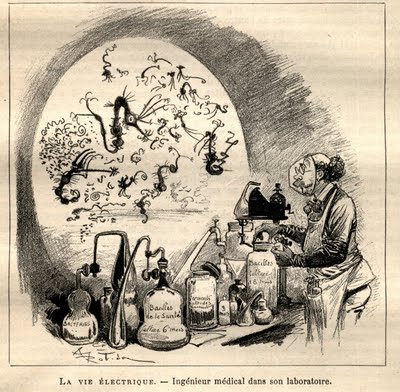
Born in 1848, Albert Robida, a French illustrator, etcher, lithographer, caricaturist, and early science fiction author, contemporary of Jules Verne, envisioned a world which was interconnected via an astonishingly prophetic device called a Téléphonoscope. It has a small phonographesque speaker/microphone and is oval in most illustrations, rectangular in the Sahara Battle image. It transmits live performances and news broadcasts from around the world, brings the classroom to the student (distance learning), connects with loved ones live (Skype), and distance voyeurism. He is best known for his trilogy of futuristic novels; in the first book, Le Vingtième Siècle (The Twentieth Century, 1883), his readers were introduced to the Téléphonoscope.
 |
| Skype predicted in 1883 by Albert Robida, grandfather of scifi illustration |
 |
| 1883 Vision of the future: (1) Watch live news from around the world (2) observe performance on screen at home (Youtube prophesy) |

 |
| Courses via Telephonoscope (Distance learning/online classes prophesy) |
The sequels of Le Vingtième Siècle, are Guerre au Vingtième Siècle (War in the Twentieth Century, 1887), and La Vie Électronique (Electronic Life, 1890). All three of these books he illustrated himself. He stands apart from Verne because Robida imagined how everyday life would be with inventions of the future, whereas Verne wrote mainly about mad scientists and their inventions.


The Twentieth Century (Middletown , CT Paris
The French cover (p VIII in English edition) portrays characters and events from the book. One of the main characters in the book, Hélène, is seen dressed as a lawyer on the lower right-hand side. Above her, we see Notre Dame with a restaurant and dirigible depot attached. On the lower left side, we have two people conversing on what Robida called a Téléphonoscope, what we call the internet today. The central figure is that of a Femme Moderne, she is an emancipated woman of the new century. Her dress is short, revealing her pants and tights underneath, yet much of her wardrobe still has very classic Victorian elements to it (corseted waist, elegant top hat, long umbrella, lace and bowtie decorations, long gloves, etc). Robida elegantly portrays the flowing of fabric with a keen eye for individual style of dress for each character. She, in combination with the two figures at her feet, comprises a triangular composition, similar to paintings from the Renaissance.
The French cover (p VIII in English edition) portrays characters and events from the book. One of the main characters in the book, Hélène, is seen dressed as a lawyer on the lower right-hand side. Above her, we see Notre Dame with a restaurant and dirigible depot attached. On the lower left side, we have two people conversing on what Robida called a Téléphonoscope, what we call the internet today. The central figure is that of a Femme Moderne, she is an emancipated woman of the new century. Her dress is short, revealing her pants and tights underneath, yet much of her wardrobe still has very classic Victorian elements to it (corseted waist, elegant top hat, long umbrella, lace and bowtie decorations, long gloves, etc). Robida elegantly portrays the flowing of fabric with a keen eye for individual style of dress for each character. She, in combination with the two figures at her feet, comprises a triangular composition, similar to paintings from the Renaissance.
Robida’s art is highly stylized: curves, ovals and hour-glass shaped women populate his illustrations. His female characters are realistically rendered whereas many of the males look like caricatures; rounded noses, eccentric mustaches and beards.
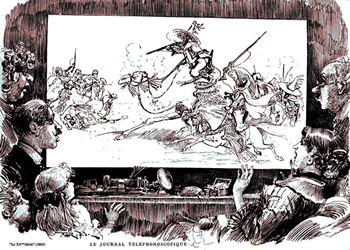 |
| Witnessing a battle in the Sahara p 182 |
 |
| Enjoying theatre in the home |
 |
 |
| Possible Indiscretions p 65 |
Robida was a product of his time, and envisioned the future through the eyes of a man of his era. Although his art portrays the future, it is still highly stylized in the Victorian taste. There are many elegant curves and intricate ironwork that are reminiscent of the design used on the Eiffel Tower France
Paris presents us with a saturation of advertisements: billboards, signs, and dirigibles flood our view selling everything from clothes and banks to apartments and newspapers. This is comparable to Piccadilly Circus or Times Square today. Although Trilingual Theater represents a live performance of one play shown simultaneously on three levels, each in a differnet language, it conjures up modern-day DVD technology, where the language changes at a touch of a button.
Robida’s illustrations depict few nature scenes and are primarily of urban settings and the individuals who live there, although, some of his panoramic views of the urban landscape show plumes of smoke and soot coming from the stalks of factories and chimneys (Robida, p. 69). He was well aware of the polluting aspect of Industrialization. Paris by Night stands out amoung his illustrations as one of a handful of watercolours in this book. It depicts a couple in a private flying machine crusing over the city on a lovely night. They share the sky with larger dirigibles shining headlights evocative of fisheyes.

 |
| Paris p 8 |
 |
| Trilingual Theater p 103 |
Robida’s illustrations depict few nature scenes and are primarily of urban settings and the individuals who live there, although, some of his panoramic views of the urban landscape show plumes of smoke and soot coming from the stalks of factories and chimneys (Robida, p. 69). He was well aware of the polluting aspect of Industrialization. Paris by Night stands out amoung his illustrations as one of a handful of watercolours in this book. It depicts a couple in a private flying machine crusing over the city on a lovely night. They share the sky with larger dirigibles shining headlights evocative of fisheyes.

Franco-English Tube is Robida's concept for our current Chunnel. Mrs. de Saint-Panachard attacked has two women dueling. Both illustrations use diagonal lines to create a dramatic effect. Robida's female characters are emancipated: many are lawyers, doctors, and politicians.
Robida is the father of science fiction illustration, having inspired science fiction artists and writers who followed him. Many of his visions of the future came to pass. His books and art are well known in France and have influenced many comic book (Bande-desinee) writers and artists such as Herge's Professor Calculus from Tintin from Belgium and, more recently, Brian Talbot's Grandville graphic novel from England. Robida's vision is amazing and unforgettable.
~~~~~~~~~~~~~~~~~~~~~~~~~~~~~~~~~~~~~~~~~~~~~~~~~~~~~~~~~~~~~~~~~~~~~~~~
 |
| Paris by Night p 84 |
ALBER ROBIDA NEWS: HYPNAGOGIC TELEGRAM, my band, performed a CHAPLIN dance in ROBERT ROBIDA dress w/ 1902 George Melies film Trip to the Moon aka Voyage dans la Lune as backdrop (as seen in Johnny Depp produced Hugo film). More costume time travel Doctor Who inspired vaudeville songs to be posted. Youtube channel DAINASURREALISM
Tuesday, March 15, 2011
Review of Momo by Michael Ende (Doubleday, 1985)
“Never Forget to Stop and Smell the Flowers” by Chicago Surrealist Group member, and Lithuanian performance artist, DainaSurrealism
Although categorized as a children’s book, Momo (also known as The Gray Gentlemen or The Men in Gray), may appeal to a wide spectrum of adults with its thought-provoking social criticism . Michael Ende (1929 – 1995) published Momo in German in 1973 (translated into English in 1985). Ende is best known for his book Neverending Story (German version, Die Unendliche Geschichte, 1979: English translation, 1983).
Although categorized as a children’s book, Momo (also known as The Gray Gentlemen or The Men in Gray), may appeal to a wide spectrum of adults with its thought-provoking social criticism . Michael Ende (1929 – 1995) published Momo in German in 1973 (translated into English in 1985). Ende is best known for his book Neverending Story (German version, Die Unendliche Geschichte, 1979: English translation, 1983).

(Con't) Ende’s writing style was influenced by his father, the famous surrealist painter, Edgar Ende. The surrealist ideals of rebellion against conformity and fighting society’s numbing of the spirit of imagination is evident throughout his work, but nowhere more so than in Momo. The main characters in Ende’s books are misfits who resolve to be themselves despite external pressures. The protagonist, a young girl called Momo, is the epitome of non-conformity: she wears old clothes, has raggedy, unkempt hair, and lives in a small room under the ruins of an ancient amphitheater; she is a run-away from an orphanage and refuses to wear shoes. Since the amphitheater is on the outskirts of an unnamed city, the story could take place anywhere in southern Europe and anytime, giving it a fairytale quality.
~~~~~~~~~~~~~~~~~~~~~~~~~~~~~~~~~~~~~~~~~~~~~~~~~~~~~~~~~~~~~~~~~~~~~~~
Strange Interlude: MOMO NEWS: HYPNAGOGIC TELEGRAM (my cabaret band) in rehearsal with our MOMO song "Walking Backwards Thru Time" (below).
GOING VIRAL w/ Chaplin dance. (below)
The CHAPLIN DANCE has backdrop of George Melies 1902 film Trip to the Moon (as seen in Hugo film), Zazie song "Dans la Lune."
Lewis Carroll, Dr Who, Dream, & Fortean inpired tunes. Multi-lingual. Silent film inspired dances. Trock. Lietuvaite soka kaip Chaplin.
~~~~~~~~~~~~~~~~~~~~~~~~~~~~~~~~~~~~~~~~~~~~~~~~~~~~~~~~~~~~~~~~~~~~~
~~~~~~~~~~~~~~~~~~~~~~~~~~~~~~~~~~~~~~~~~~~~~~~~~~~~~~~~~~~~~~~~~~~~~~~
Strange Interlude: MOMO NEWS: HYPNAGOGIC TELEGRAM (my cabaret band) in rehearsal with our MOMO song "Walking Backwards Thru Time" (below).
Lewis Carroll, Dr Who, Dream, & Fortean inpired tunes. Multi-lingual. Silent film inspired dances. Trock. Lietuvaite soka kaip Chaplin.
~~~~~~~~~~~~~~~~~~~~~~~~~~~~~~~~~~~~~~~~~~~~~~~~~~~~~~~~~~~~~~~~~~~~~
Momo and her friends lead a leisurely existence until the appearance of the ghostly Men in Gray, who coerce the populace into “saving their time” in the “Timesaving Bank,” then disappear without a trace, leaving the individuals unaware of their existence and convinced that timesaving was their own idea. Soon Momo’s friends grow irritable, rush about compulsively saying, “I have no time,” and obsess over money, in the process sacrificing their joie de vivre (joy of living). In this book, Ende illustrates the importance of a life of quality over a life of quantity.
Billboards appear declaring,
“THE FUTURE BELONGS TO TIMESAVERS”
“MAKE MORE OF YOUR LIFE, SAVE TIME”
 The book takes a radical turn when Momo organizes a demonstration of children neglected by their “time-saving” parents (quite revolutionary for a “children’s book” to teach kids how to organize a protest, no wonder this book isn’t widely available in
Ende impressively constructs rich symbolism in his characters: Momo’s extraordinary skills at being a good listener represent the importance of introspection and connecting with others; Guido, the local story-teller, who spins engrossing tales inspired by his muse (Momo), encapsulates the power of imagination; the Grays, who all look identical (with gray skin, gray suits and such unemotional voices that they even “sound gray” ), symbolize the stifling conformity and manipulative nature of capitalism; Cassiopeia, named after a bold human queen who dared to challenge the Gods in Greek mythology, embodies independence and defiance; Professor Hora, residing in Never House and wearing omni-vision glasses, personifies the inexplicable vagueness of time.


Fan art (left) and Ende's illustration for German cover (right)
Ende has Nowhere House swimming in surrealism. Cassiopeia, who can see thirty minutes into the future, slowly leads Momo in order to quickly escape the Grays, while the Grays dash about only to find that they are standing still. This is a brilliantly creative re-working of the scene from Through the Looking-Glass in which Alice and the Red Queen run as fast as they can just to stay in place. When Momo asks Professor Hora what the Grays are, he replies, “Strictly speaking, they’re nothing. They exist only because people give them the opportunity to do so.”
Ende’s skill as a social commentator is akin to Rod Serling’s in Twilight Zone since Ende skillfully uses fantasy and the bizarre as a means of thinly-veiled social criticism. Ende’s illustrations for Momo show inanimate objects and the back of Cassiopeia, purposely leaving the characters up to the imagination. Momo is a classic which reads swiftly despite its provocative insightfulness. Ende was a visionary; recognizing forty years ago which direction society was taking with consumerism and hidden interest groups, thus making Momo ring truer than ever in our modern society.


film (top) cartoon (below)
In the 1980s, big budget movie versions of Neverending Story (dir. by Wolfgang Petersen, 1984) and Momo (dir. Johannes Schaaf, 1986, John Huston playing Professor Hora) were produced in Europe . Perhaps not surprisingly, Europeans generally respond more favorably to social criticism and political activism than Americans, thus making Ende’s books well-known through-out Europe while obscure in the States. Although the films lack the depth and details of the books, they are worth viewing for their creativity and visual lavishness.

Michael Ende and friend
~~~~~~~~~~~~~~~~~~~~~~~~~~~~~~~~~~~~~~~~~~~~~~~~~~~~~~~~~~~~~~~~~~~~~~~~
MOMO NEWS: HYPNAGOGIC TELEGRAM (my band) is writing a MOMO song. I will dress as MOMO for performance art with band with scenes from MOMO film as backdrop and post on YOUTUBE. Here is us doing CHAPLIN DANCE to backdrop of George Melies 1902 film Trip to the Moon (as seen in Hugo film) on YOUTUBE.
STRANGE INTERLUDE: My Dream, Time-Travel inspired band, "Hypnagogic Telegram" is going VIRAL on Youtube. Timelord Rock. Trock. I play a timeghost (zeitgeist) that inhabits the wardrobe closet in the TARDIS. I come out in costumes from various eras to dance & sing. If Doctor Who would have a band, it might sound like this.
<---- View YOUTUBE VIDEO here.
On FACEBOOK @ HYPNAGOGIC TELEGRAM
Check out my Time Travel, Dream, surreal artwork, performance art, costuming & photography on the other blog pages!
Monday, February 28, 2011
Review of “The City of Lost Children” (aka “La Cité des Enfants Perdus” dir Jean-Pierre Jeunet and Marc Caro, 1995)
Jeunet and Caro, the same directing duo behind the post-apocalyptic black comedy “Delicatessen” (1991), present us with another masterful rendition of a dystopian society in “The City of Lost Children”. Jeunet is best known in America for his direction of "Alien: Insurrection" (1997), "Amelie" (2001), and "A Very Long Engagement" (2004). This is a visually gripping work of science fiction steampunk (speculative fiction from a by-gone time - usually Victoran era). Dream-like and whimsical, this film takes place in a mysterious port city and stars Ron Pearlman as a dim-witted yet good-hearted strongman, One, who joins forces with a young girl, Miette (Judith Vittet), and her fellow street urchins in a quest to find his adopted little brother, Denree (Joseph Lucien). Denree has been kidnapped by one-eyed cyborgs known as “Cyclopses” who plan to sell him to a small group of comical clones (all played by Jeunet regular Dominique Pinon) who work for a madman, Krank (German word for “sick”, played by Daniel Emilfork). Krank can’t dream, so he uses a mechanical machine to steal the dreams of young children. The Cyclopses are a fanatical and repressed monastic order who willingly submit to having one eye removed and replaced by a mechanical contraption as part of their initiation rite.


The characters in this film are unique and bizarre: evil ex-sideshow Siamese twins called “Octopus” use a classroom as headquarters for street urchin child-thieves; Marcello (Jean-Claude Dreyfus), an opium-addicted former sideshow boss of the Octopus has trained assassin fleas with attached poison vials; and Uncle Irvin is a migraine-ridden brain floating in an aquarium and utilizes an optical lens and two gramophone-like steampunk speakers to communicate.
The film's subdued colors in combination with the costume designs by Jean-Paul Gautier evoke the depression era of the 1930s, yet the technology is futuristic, creating a distinct vagueness in regard to whether this takes place in the past or in the future. The multiple dream sequences are visually stunning, non-the-least-of-which is the scene where Miette confronts Krank and they engage in a dance during which Miette transforms from an 8 year old to an old woman in less than a minute. The soundtrack consists of both mesmerizing sideshow organ-grinding tunes as well as comical songs, such as the one about Santa Clause and one about short gnomes (sung with a dance number by one of the clones).
http://www.youtube.com/watch?v=BmcaRC2mSkY
Jeunet and Caro brilliantly use a Rube Goldbergesque series of chain-reactions in every film of theirs and “City of Lost Children” is no exception. Here we see how Miette’s teardrop hits a spider web, waking a parrot, who chirps, making a dog bark, waking a hobo who throws a liquor bottle, etc until we have a car accident, a power outage, and a ship crashing into the dock. Another memorable scene is when Krank has one of the clones recite a charmingly fanciful nonsense poem to him in order to help him fall asleep. The clone sits next to Krank and speaks…
“The sea is blue like the sky/And the sky is blue like the South Seas/I don’t know if I’m swimming in the sky
/Or flying in the sea/The hammerhead shark plays xylophone with the catfish bones/The walrus plays Jew’s
harp with the sperm whale’s suspenders/Igloos turn into Mushrooms”

The fact that this film has no love-story is most admirable. The plot progresses naturally without the tacked-on love-stories which snag plot movement in more formulaic films. This is an exceptional film with a dazzling array of uniquely twisted characters and spellbinding visual effects. Remarkably superb scenes weave their way throughout the film and Marianne Faithful’s track “Who Will Take My Dreams Away?” played during the closing credits wraps the film up beautifully.

Jean-Pierre Jeunet has a new comedy/drama "Micmacs" (2009) which is about a man who got shot in the head and joins a rag-tag group of outcasts in order to bring down the weapons manufacturer which produced the bullet.
~~~~~~~~~~~~~~~~~~~~~~~~~~~~~~~~~~~~~~~~~~~~~~~~~~~~~~~~~~~~~~~~~~~~~~~~
STRANGE INTERLUDE: My Dream, Time-Travel inspired band, "Hypnagogic Telegram" is going VIRAL on Youtube. Timelord Rock. Trock. I play a timeghost (zeitgeist) that inhabits the wardrobe closet in the TARDIS. I come out in costumes from various eras to dance & sing. If Doctor Who would have a band, it might sound like this.
STRANGE INTERLUDE: My Dream, Time-Travel inspired band, "Hypnagogic Telegram" is going VIRAL on Youtube. Timelord Rock. Trock. I play a timeghost (zeitgeist) that inhabits the wardrobe closet in the TARDIS. I come out in costumes from various eras to dance & sing. If Doctor Who would have a band, it might sound like this.
<---- View YOUTUBE VIDEO here.
On FACEBOOK @ HYPNAGOGIC TELEGRAM
Check out my Time Travel, Dream, surreal artwork, performance art, costuming & photography on the other blog pages!
Monday, February 21, 2011
Review of "Copyright Criminals" (Directed by Benjamin Franzen and Kembrew McLeod, 2009)
Filmmakers Benjamin Franzen and Kembrew McLeod explore the debate over sampling in the music industry with their 54 minute documentary, Copyright Criminals. Various individuals are interviewed presenting a spectrum of viewpoints: sound engineers, DJs, record industry lawyers, media professors, samplers, as well as those getting sampled. The wide range of opinions makes for a stimulating analysis of the topic. The lawyers say that sampling is using other people’s work without their permission and without paying royalties (“Thou shall not steal”); the samplers say they are paying homage to the original artists. Igor Stravinsky is quoted as saying, “A good composer does not imitate, he steals.” The most fascinating perspective of all those interviewed is that of Clyde Stubblefield (James Brown’s drummer from 1965 – 1970, the most sampled drummer in hip-hop), who says that he doesn’t care about the money (royalties), he just wants to get credited on the albums.
Copyright Criminals discusses the history of music sampling, starting with the Beatles’ use of found tapes and sound loops in “Revolution 9”, “Tomorrow Never Knows”, and “I am the Walrus”, to Public Enemy, and Prince. The Beatles certainly weren’t the first to sample; the documentary could have named specific artists sampling further back in recording history (for example Jazz, Hollywood musicals, Blues, etc).
The collage-like use of split-screen to compare the original music on one side to that of the sampled piece on the other is a metaphor for how sampling is itself a form of collage. It helps to illustrate how samples are used and how they have been altered. It is a valuable aid for the viewer to come to their own conclusion as to where they stand on the issue. The editing is straight-forward without any choppy or distracting cuts.
Many compelling points are made, not the least of which is that if a musician was to go through the legal channels and use a sample in their work, the producer would make a cut of the royalties, but the actual musician who played the original may not.
The advent of a new art-form always brings up the debate “is this art, or is it just the work of lazy people who can’t be bothered to create something new?” Shock G of Digital Underground makes a valid point when he says, “It’s easier to snap a picture with a camera than it is to paint a picture. What the photographer is to the painter, is what the modern producer, DJ, or computer musician is to the instrumentalist.” We are asked to consider “what is art?” Andy Warhol’s Campbell’s Soup Cans and Pop Art are brought up as examples of how art has historically re-invented the old in order to present something in a new light. Steve Wonder’s “Pastime Paradise” sold more as a sample. George Clinton says Snoop Dog’s sample of “Atomic Dog” revitalizing Clinton’s record sales after people who heard the sample wanted to hear the original.
Copyright Criminals is a thought-provoking work which presents multiple facets of this heated debate. Grainy vintage footage of the Notorious B.I.G rapping as a teenager on the streets of Brooklyn evokes scenes of street rappers in “Wild Style” (Directed by Charlie Ahearn, 1983). The filmmakers present the discussion in a clear and in depth manner. The viewer is encouraged to come to their own conclusions on the issue.
Monday, February 14, 2011
Review of The Adventures of Cheburashka & Friends DVD (dir. Roman Kachanov) Чебура́шкa
Based on the Russian children’s book Cheburashka (1965) by Eduard Uspensky, this series of four stop-motion animated shorts features Cheburashka, a cheerful bear-like creature, and his best friend, Gena, a crocodile who works at the Zoo but lives in the city. Cheburashka is almost Chaplinesque in how he combines charm and melancholy when he tries to find his place where nobody knows what he is or where he came from (even the scientists at the Zoo reject him because they don’t know what species he is!). The animation style is charming and sentimental, without the stereotypical characters and sappiness so often found in Disney animation. The characters are unique and full of personality. Gena plays solitaire chess and puts up fliers throughout the city looking for friends; Shapoclyak, an old lady who has a rat living in her purse, goes breaking windows, stealing things, and causing general chaos.
Much of the incidental music is played on violins, acoustic guitars, and/or accordions, giving it an almost chanson feel. Two of the episodes feature catchy songs with endearing, sentimental lyrics. Episode 2, called Cheburashka, opens on a rainy day with Gena playing accordion and singing "The Birthday Song".
“It’s unclear to the passersby,
On this rainy day,
Why I’m so happy…It’s a shame that a birthday comes just once a year”
On this rainy day,
Why I’m so happy…It’s a shame that a birthday comes just once a year”
Shapoclyak (episode3) closes with Cheburashka, Shapoclyak, and Gena sitting on the caboose of a blue train. As they roll away, Gena plays the accordion and sings "Blue Wagon".
“Slowly the minutes are floating away
Don’t expect to meet them anymore
Even if giving up the past is a bit sad
It’s still best to go ahead…
To all new adventures we are rushing, my friends,
Hey, train driver, give some more speed!
Why, oh, why is this day ending?
Let it last the whole year!”
These songs are tremendously popular in all of the former Soviet republics. Adults sing these Cheburashka songs at parties; children sing them as they play. Russia has a long tradition of fairy-tales (skaski) being a major part of its cultural identity, much the same way that bande dessinée (comic books) are part of French and Belgian culture, with adults being equally fans of the genre as children. The line between fairy-tales and cartoons (multiki) is blurred in Russian culture with Cheburashka being the most famous and beloved of all Russian cartoon characters. He has become a cultural icon. Cheburashka is the official mascot of the Russian Olympic team, seen as the stuffed toy waved around by all their athletes at the opening and closing ceremonies since the Summer Olympics in Greece in 2004. He has become popular in Japan and among anime fans internationally. TV Tokyo has announced that it is producing an anime series of Cheburashka, as well as producing a full length feature.
Cheburashka was produced by Soyuzmultfilm (Union Animation in English), Russia’s premier animation company based in Moscow, which was founded in 1936 and has produced over 1500 animated shorts and films in that time. Soyuzmultfilm stands out as both a highly productive and experimental company. Their productions span a wide spectrum of styles; from vibrant films with dancing and singing, to sparsely atmospheric films with odd sound effects, to cut-out animations of 14th - 16th century icons and frescos, to dark animation reminiscent of Jan Svankmayer’s surrealist shorts. Themes include such diverse subjects as history, fairy-tales, science fiction, existentialism, the cost of war, and feelings of social isolation amongst others.
The English subtitles on this DVD are well translated, although the subtitles on the last episode (Cheburashka goes to School) are a bit out-of-sync (running about 2 sentences behind the actual dialogue), but since the action isn’t so fast, it is still easy to follow. Cheburashka is a treasure from Soviet-era Russia. Hauntingly beautiful music and melancholy lyrics combine with amiable characters for an incomparably unique stop-motion experience for all ages.
As an added treat, we get Vasili Livanov voicing Krokodil Gena. He has a velvety rich voice which is familiar to Russian fans of a series of "Sherlock Holmes"films. He played Sherlock so splendidly, that he was awarded an honourary Member of the British Empire for his "service to the theatre and the performing arts." A sculpture of Livanov and Vitaly Solomin (who played John Watson) in their now-famous roles, finds its home alongside the Embassy of the United Kingdom in Moscow. He is a brilliant actor, and his distinctive and melodic voice is worth hearing even if you don't speak/understand Russian. Benedict Cumberbatch and Vasili Livanov share a) the fact that they both played distinctively different and unforgettable versions of Sherlock Holmes, and b0 they are both immaculately smooth voice actors. If language is music, than their voices are harmonious melodies.
The DVD runs 67 minutes and is in the original Russian with the option of English subtitles.
The DVD runs 67 minutes and is in the original Russian with the option of English subtitles.
4 episodes: Crocodile Gena (1969), Cheburashka (1971), Shapoclyak (1974), Cheburashka Goes to School (1983).


~~~~~~~~~~~~~~~~~~~~~~~~~~~~~~~~~~~~~~~~~~~~~~~~~~~~~~~~~~~~~~~~~~~~~~~~
STRANGE INTERLUDE: My Dream, Time-Travel inspired band, "Hypnagogic Telegram" is going VIRAL on Youtube. Timelord Rock. Trock. I play a timeghost (zeitgeist) that inhabits the wardrobe closet in the TARDIS. I come out in costumes from various eras to dance & sing. If Doctor Who would have a band, it might sound like this.
<---- View YOUTUBE VIDEO here.
On FACEBOOK @ HYPNAGOGIC TELEGRAM
Check out my Time Travel, Dream, surreal artwork, performance art, costuming & photography on the other blog pages!
On FACEBOOK @ HYPNAGOGIC TELEGRAM
Check out my Time Travel, Dream, surreal artwork, performance art, costuming & photography on the other blog pages!
Subscribe to:
Posts (Atom)
